November is such a confusing month to travel, isn’t it? It’s freezing when your Uber picks you up at 5 a.m., but by the time you’re checking into your hotel at noon, you’re sweating through your collar. How do you pack for something like that?
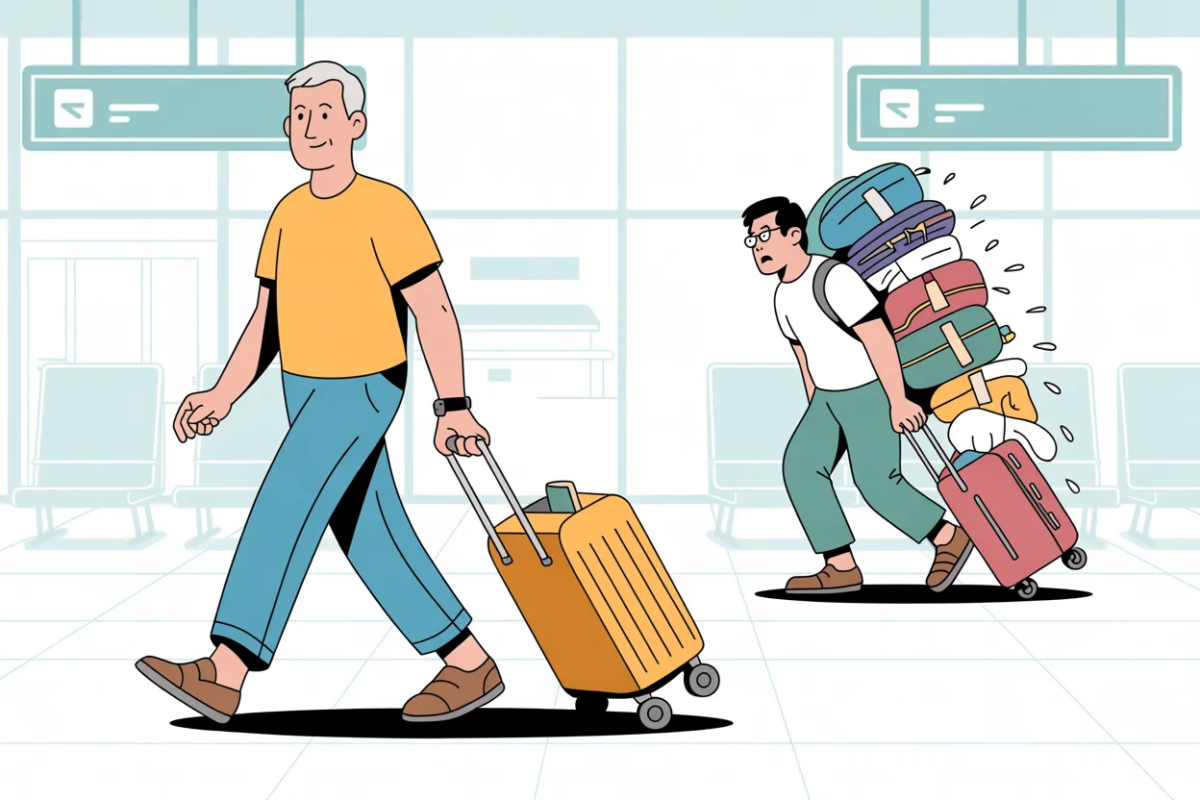
It’s tempting to bring everything: the waterproof shell, a backup blazer, the “just-in-case” dress shoes. By the time you zip up your roller bag, you’ve essentially packed the contents of a small apartment and you’re begging the gate agent not to charge you an overweight luggage fee. Knowing what not to pack saves more room than any packing cube.
Overpacking got more expensive this year. In April, the major U.S. airlines raised the fee for a first checked bag to $45 on most domestic routes. American now charges basic economy passengers $55.
Overpacking starts in your head, with a voice that keeps asking “what if?” November, with its 40-degree mornings and 70-degree afternoons, is a good month to break the habit. Who knows? It could save you a few bucks in bag fees, too.
Why do travelers overpack in November?
No new suitcase or clever gadget will fix this. You have to decide what stays home.
For example, luxury travel advisor Phil Lockwood uses a lightweight jacket and a vest that compress smaller than a paperback. He layers a warm vest over a button-down. That keeps him comfortable through three seasons. But his biggest downsizing involved his shoes.
“Shoes take up an incredible amount of space because they’re bulky and oddly shaped,” he explains. “I went from packing a variety — workout shoes, walking shoes, dress shoes, leather flip-flops, rubber flip-flops — to packing none at all and instead just wearing a pair of versatile running shoes.”
Andy Abramson ditched his specialty travel clothes for the same reason. These extra items were bulking up his luggage and were only marginally useful at his destination.
“I realized I did not need to carry contingency plans through the airport,” says Abramson, who runs a communications company in Las Vegas. “I only needed what was essential for the flight itself and for where I was landing.”
They’re both right. As someone who lives on the road, I can tell you that less is more and that the travel clothes and luggage you see advertised are meant for tourists, not pros. The experts carry less, not more.
Does a travel uniform work?
Another November mistake is packing variety. Different outfits for every day, because what if you feel like wearing teal on Thursday?
Frequent travelers know that their wardrobe is a uniform: a blue blazer, black T-shirts, khaki pants. Unless you’re trying to make a fashion statement, you’ll want to be plain and boring.
One benefit of packing a uniform is that it’s completely interchangeable, and, if necessary, rewearable. (I’m not going to go into details.)
But by “boring” I also mean be a minimalist.
What not to pack in your suitcase
Here are five things to strike from your November packing list:
A second pair of shoes. “Once you find a pair that can do double duty — stylish enough for dinner but comfortable enough for long walks — the rest of your packing tends to fall into place,” says Susie Piegza, co-founder of Classic Journeys. (I wear versatile but very comfortable Kuru Atom Trail sneakers, which are almost discreet enough to pass for dress shoes.)
A backup jacket. You only need a light jacket at this time of year unless you’re headed to the Arctic. Don’t pack an in-between jacket or a specialty travel jacket. They’ll just bulk up your bag.
A heavy sweater. Merino wool keeps you warm without much bulk. It also resists odor, so you can wear it several times before anyone notices. Dog trainer Teddy Wall swapped his bulky warm layer for a Smartwool long-sleeve shirt and still packs it. “It handles 40-degree mornings without the puffy-coat bulk,” he said, “and doesn’t feel gross by afternoon when it’s 70 degrees.” Also, a merino base layer takes up the same space as a magazine.
Formal wear. Unless you’re meeting the pope, a blazer and dark jeans will get you into most restaurants, hotels and business meetings. Rusty Meador, founder of the clothing brand Beach & Barn, even ditched his wool blazer entirely. “Airports and businesses have become so casual that a lightweight canvas blazer seems like a tuxedo by comparison,” he said. Pack one unstructured blazer and leave the rest.
The “just in case” kit. Almost every hotel I stay in supplies soap and shampoo. Stop hauling a zip-top bag full of contingency grooming products through the security line. Jay Ellenby, president of Safe Harbors Business Travel, nominates the full-size travel umbrella as his most useless item. “It’s bulky, it breaks, and every hotel, drugstore, and airport terminal sells one for $5 if you genuinely need it,” he says. The same logic applies to the backup moisturizer, the duplicate deodorant, and whatever else you’re cramming into that quart bag “just in case.”
Can you travel with just a personal item?
If everything fits in a personal item, you won’t pay a bag fee on any U.S. airline. With first checked bags now running $45 on most major carriers, that adds up.
Ellenby says his corporate clients saw a difference when they packed lighter.
“The real improvement wasn’t just speed through the airport,” he said. “It was lower stress overall, which directly improved how they showed up in meetings. Lighter bag, sharper focus.”
What if you run out of things to wear? Bill McIntyre, a director at Global Rescue, says there’s a workaround for that, too.
“Pack half of what you think you need,” he advises. “Then find the neighborhood laundromat, and you’ll move through your destination fresh, nimble, and more immersed than any overpacked traveler ever could.”
By the way, visiting a laundromat can be a cultural experience in some cities. It’s a neighborhood bar without the beer — locals, conversation, 30 minutes of unscheduled life.
November will try to trick you. The forecast will say “variable.” Your brain will say “what if?” Your closet will call to you with its fleeces and rain shells and that jacket with all the pockets.
Ignore all of it. Pack the blazer and the merino shirt, and bring just one pair of shoes. Leave the rest behind.

Have a question about this story? Tell us what happened — we read every comment.
Join the conversation