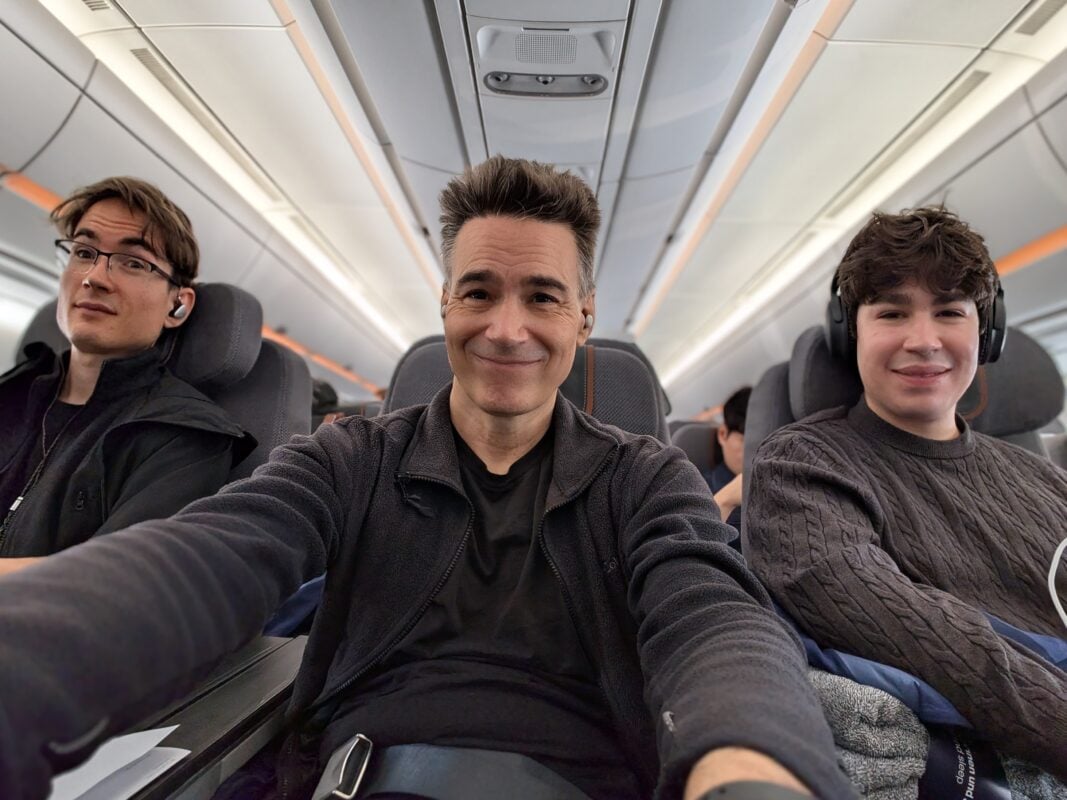
I almost always get stuck in a middle seat, so I consider myself something of an expert when it comes to surviving aviation’s worst conflict zone.
But I’m also lucky, because I usually fly with my adult sons. The boys let me use both armrests, and I can spread out and get up to stretch my legs whenever I want to, so there’s practically no conflict.
That’s not the usual reality of the middle seat experience.
For most travelers, the middle seat is a contact sport. As jacket weather makes already tight quarters feel even tighter, millions of passengers are about to spend hours wedged between strangers. They’ll fight over plastic armrests and slowly lose their minds at 35,000 feet.
Alex Gervash, an experienced commercial airline pilot, explains that the middle seat triggers a psychological mechanism called perceived loss of control.
“When you can see the aisle or the window, your nervous system stays calmer,” he says. “In the middle, both are blocked by strangers’ bodies. Your brain interprets this as confinement, and your fight-or-flight system activates at a low level for the entire flight.”
That doesn’t have to be you. The new rules of middle-seat survival require mastering armrest diplomacy with humor, building an impenetrable personal gear bubble, applying jacket weather hacks for extra space, and using ergonomic micro-movements to avoid physical injury.
Armrest diplomacy: Establishing the truce
Let’s start with the oldest argument in commercial aviation: who owns the armrests? The answer, according to etiquette professionals, is clear.
“Both middle armrests belong to the middle-seat passenger,” says Adeodata Czink, an etiquette expert with Business of Manners. The window seat gets the wall. The aisle seat gets freedom of movement. The middle seat gets both armrests — that’s the deal.
Jodi RR Smith of Mannersmith Etiquette Consulting agrees, adding the nuance that consideration should temper ownership. If you’re a smaller person and the person next to you is “folding themselves into an origami-yoga pose” to fit in the seat, share. Humans aren’t just territorial creatures — they can also empathize. Use it.
But knowing the rule and enforcing it are two different things. Stephanie Ward, a veteran of basic economy middle seats, has a system. She introduces herself immediately, then deploys a single joke.
“The middle seat gets both armrests — that’s the rule — but I promise not to get up to go to the bathroom every 30 minutes,” she says.
People laugh. Then she plants her elbows, staking out her territory.
What kind of gear do you need to survive a middle seat?
If armrest diplomacy is the offense, gear is the defense. And nobody has assembled a more complete defensive package than Katharine Nohr, a Hawaii-based attorney who travels frequently and has spent years optimizing her middle-seat survival kit.
Her setup: two inflatable lumbar pillows (one for her back, one as a footrest), a tested inflatable neck pillow, an eye mask, a hood to cover her face, special slippers in a small case, an infinity scarf that doubles as a blanket, a water bottle clipped to the seat back with a carabiner, noise-canceling headphones, a small pouch with essentials, and a jacket engineered with pockets. The whole kit compresses into a thin backpack that fits inside a larger carry-on.
“I’m the most comfortable coach passenger on the plane,” she brags.
Jacket weather hacks: The coat as a tool
Fall and winter bring a complication: bulky outerwear. Coats don’t fit cleanly in overhead bins once the flight is full, and dragging a heavy jacket onto your lap in an already-compressed seat can feel like wearing a straitjacket.
Christopher Jimenez, a board-certified hip and knee surgeon, has a better idea. He doesn’t wear a coat in the seat at all. Instead, he rolls it tight and uses it as a lumbar bolster at beltline height. This prevents in-flight back pain.
One underused option: Stow the coat in the overhead before your neighbors board. Flight attendants frown on this, but as former attendant Celeste Bell points out, “holding on to a big coat in a middle seat can feel claustrophobic.” She doesn’t wait until the flight is fully loaded and finds a slot for her winter coat.
Don’t wreck your body
Lou Ezrick, a physical therapist who sees the aftermath of holiday travel every January, has a warning: Avoid the isometric shrug.
“The single biggest physical mistake middle seat passengers make in cold weather is that they tense their shoulders upward against their neighbors reflexively,” Ezrick says. “They essentially do an isometric shrug for three hours straight.” The result: a guaranteed pain in the upper back. He recommends consciously dropping your shoulders down and back every 20 minutes. Set a phone timer if necessary.
Thomas Jeneby, a board-certified plastic surgeon who manages long operating room days, treats the middle seat like a surgical procedure: circulation and micro-movements matter more than willpower. His timed routine: every 30 to 40 minutes, do 10 ankle pumps, 5 glute squeezes, and 3 slow chin tucks. It takes about 90 seconds and dramatically reduces swelling and neck tension.
His middle-seat rule is “neutral spine, elbows in, pelvis anchored.” Keep your forearms vertical rather than splayed outward. Feet flat. Don’t torque your hips trying to create space that isn’t there.
Can an app get you out of the middle seat?
The best way to survive the middle seat is to never sit in it. American Airlines just made that a little easier. Last month, it added a feature to its app that watches the seat map for you. After you book, you tell the app whether you want a window, aisle or middle seat. If a matching seat opens up, the app moves you and sends a notification.
There’s fine print. You have to be an AAdvantage member traveling alone with an assigned seat, and the monitoring stops 24 hours before departure.
United has offered a similar tool in its app since 2024.
Whose fault is this?
Let’s assign blame where it belongs: with the airlines.
“The middle seat is about physics, not etiquette,” says Joe Cronin, president of International Citizens Group, an insurance company that works with frequent travelers.
Until they give you more room, it’s up to you to figure out a solution. The travelers who handle it best treat the middle seat as a psychological challenge rather than a physical one. They come prepared. They establish their space early, through humor or gear or a well-placed coat, without starting a turf war. They protect their bodies from the slow structural damage of static posture. And they manage their expectations enough to arrive functional.
Or you could just travel with your kids, where the concept of personal space is more negotiable.

Have a question about this story? Tell us what happened — we read every comment.
Join the conversation