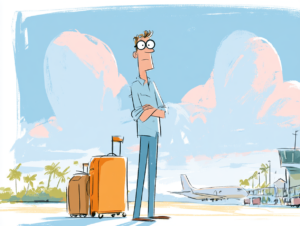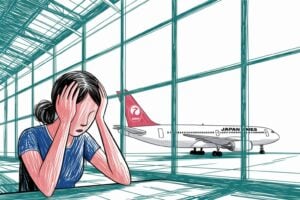
Just a few minutes before she was supposed to take off from Atlanta on her way to New Orleans, Delta Air Lines canceled Irene Sanders’ flight.
Well, technically, everyone’s flight was canceled. It was Black Friday at the Federal Aviation Administration: Nov. 13, 2026.
Sanders and her husband had a three-night Airbnb stay waiting at the other end — a birthday present to her.
Then the FAA ordered a nationwide ground stop, and you already know what happened next. Airlines canceled thousands of flights that afternoon. The delays rippled through the weekend. Delta couldn’t get them to New Orleans until Monday, their checkout day.
The Sanders never set foot in the rental, but they paid $1,450 for it anyway, which included a cleaning fee for a unit nobody slept in.
Sanders wants some of that money back.
“None of this is our fault,” she told Airbnb the morning after the ground stop. “I’m OK with a travel credit, but I hate eating $1,450 for something I can’t use.”
Both her host and Airbnb turned her down. On paper, her case looks like a loser. Airbnb’s rules allow the host to keep the money. But the more I learned about what happened on November 13, the less sure I became. Should I advocate this case?
The day the FAA stopped every departure
The FAA says a technical problem hit its telecommunications network at about 3:30 p.m. Eastern time on November 13. The agency halted departing flights across the country for more than four hours. Operators canceled about 12,462 flights on that day, including 9,082 by major airlines. The FAA notes that the ground stop didn’t directly cause all of them.
Nobody at Delta caused this. Neither did any passenger. It’s what lawyers call force majeure, an event outside everyone’s control.
The airlines treated it that way, too. Delta waived change fees for customers caught in the mess and gave them until November 22 to travel.
A cleaning fee for a cleaning nobody needed
Sanders’ host, David, messaged her through Airbnb as the news broke that Friday afternoon.
“I am sorry it’s happening just as you’re leaving!” he wrote. “As of right now I would not be able to offer a reschedule but if your flight ends up being canceled I recommend reaching out to Airbnb support directly as this may fall under their extenuating circumstances policy.”
Her flight was canceled. Sanders asked David for one thing: a refund of the cleaning fee. Nobody had used the unit, so there was nothing to clean. She also offered to take a credit toward a future stay instead.
He refused both. She says he kept sending her check-in instructions and tips on things to do in New Orleans anyway. Nice touch.
So she took his advice and went to Airbnb.
An Airbnb AI assistant told her the Major Disruptive Events Policy excludes flight cancellations. It also noted that her free cancellation deadline had passed on October 23. Her reservation was now nonrefundable.
She asked for a person. A support specialist checked with the host.
“We got the update from the host, and they’re denying the refund,” the specialist wrote. “Please coordinate with the host, since refunds depend on the host’s discretion under the policy, and we can’t override it.”
Sanders kept pushing.
“We are not asking for a complete refund, we are just asking for some compensation,” she wrote.
The next morning, a senior case manager tried to call her. The call didn’t connect. So the case manager put it in writing: Airbnb was “unable to override the policy.”
“We did not ask for special treatment,” she later wrote to me. “We never set foot in the property, yet we paid full price, including a cleaning fee for a cleaning that was never needed.”
Sanders says she and her husband have rented through Airbnb for years. They’ve earned five-star reviews as guests. She wants Airbnb to refund at least the cleaning fee and its own service fee. She’d also accept a partial refund or a credit for the rest. She values her claim at $1,200.
By then, her patience had run out.
In a message to David, she wrote that keeping every dollar for a stay that never happened put him “in the same category as the people charging outrageous prices during a crisis.” She also promised him a bad review.
What Airbnb’s rules say
Sanders believes Airbnb has no policy for a nationwide shutdown of air travel. That’s almost true.
Airbnb’s Major Disruptive Events Policy lets guests cancel for a refund or travel credit when a large-scale event at the destination prevents a stay. It overrides the host’s cancellation policy.
The covered events include government-declared public health emergencies, mandatory government travel restrictions such as evacuation orders, war and terrorism, prolonged utility outages and unforeseeable natural disasters. The event has to affect the reservation location.
Airbnb won’t cover something that only affects a guest’s ability to get there. Its list of exclusions also names “transportation disruptions such as airline insolvency, flight cancellations, transportation strikes” and some road closures.
For everything else, Airbnb tells guests and hosts to work out a deal on their own, such as a full or partial refund or new dates. Any refund outside the cancellation policy is up to the host. Airbnb says it doesn’t take part in those refunds or guarantee them. Sanders’ host had the option to bend. He chose not to.
Wait, didn’t the airlines give themselves a pass?
Now look at what the airlines owed their passengers for the same event. Under Department of Transportation rules, if an airline cancels a flight and a passenger like Sanders decides not to travel, she gets a full cash refund.
That part is solid. But the meal vouchers and hotel rooms the big airlines promise on the DOT’s customer service dashboard apply only when the airline causes the disruption. The FAA ordered this one, so those promises didn’t kick in. Some airlines handed out vouchers on a case by case basis. None had to.
The airlines are about to get more room. Starting in February, a new federal rule pulls 10 kinds of events out of the “air carrier” category in federal delay reports. They’ll no longer count against the airlines. One is a government system failure that unexpectedly keeps an airline from operating safely. That describes November 13 pretty well. The rule also moves some unscheduled maintenance problems out of the airlines’ column.
So when the system breaks, airlines have a written exemption. The FAA’s ground stop qualified. Airbnb has a similar exemption in its own policy. Sanders got nothing.
Is there a case for an exception?
I see a few. Let’s start with the ground stop itself. This wasn’t one airline canceling one flight. It was a federal order that halted every departure in the country, including flights into New Orleans.
Airbnb’s policy covers mandatory travel restrictions imposed by a government agency. A nationwide ground stop sounds a lot like one, even if it lasted only an afternoon.
Then there’s the cleaning fee. Sanders’ host didn’t have to clean anything. Refunding it would only return money for work the host never did.
Even David seemed to think Airbnb might step in. His first message sent Sanders to Airbnb support. Airbnb then told her the refund was up to him. Each side pointed at the other, and Sanders was left in the middle.
Airbnb has also made exceptions before. In 2020, a reader asked me for help after a host refused a refund for a Washington, D.C., rental early in the pandemic. Airbnb’s extenuating circumstances policy didn’t cover the capital at first.
Airbnb later broadened it and promised the guest a refund. In another case, Airbnb returned Carl Baeuerlen’s $282 deposit on a Lanai rental after I contacted it. That booking fell outside its pandemic policy, too. When a host canceled on Curtis Rahman a day before his arrival, Airbnb covered the extra $1,300 he spent on a new place. It tossed in a $200 coupon for good measure.
The case against
Rules are rules. Sanders booked a listing under a cancellation policy her host chose and she accepted. Her free cancellation window closed on October 23, three weeks before the trip. Her host lost a three-night booking on a few hours’ notice. He probably had little chance of filling those nights on a Friday afternoon.
Travel insurance exists for this kind of problem. A policy with trip cancellation coverage might have reimbursed the prepaid rental. Sanders didn’t say whether she had coverage.
Some of you will also ask why the couple didn’t drive. New Orleans is roughly seven hours from Atlanta by car. Airbnb could argue the stay wasn’t impossible, only inconvenient.
Her parting shot at David may not win her much sympathy from the hosts reading this, either.
Should I take this case?
I keep coming back to the airlines. The industry decided that a government system failure isn’t its problem. Federal regulators agreed. Passengers were left with the hotel bills and the ruined weekends. If a ground stop was beyond Delta’s control, it was beyond the control of the couple sitting in Delta’s seats, too.
If airlines can give themselves a license to walk away from an event they didn’t cause, maybe their customers can claim the same license. Then again, Airbnb wrote its exclusions in black and white. Maybe Sanders should have read them before she booked.
So I need your help, dear readers. Should I take Irene Sanders’ case to Airbnb and ask it to refund at least the cleaning and service fees? Or are rules really rules?
Resolve it yourself
Stuck with a complaint? Build your path to a fix.
Answer two quick questions and get a step-by-step plan tailored to your situation.
Your plan

Have a question about this story? Tell us what happened — we read every comment.
Join the conversation