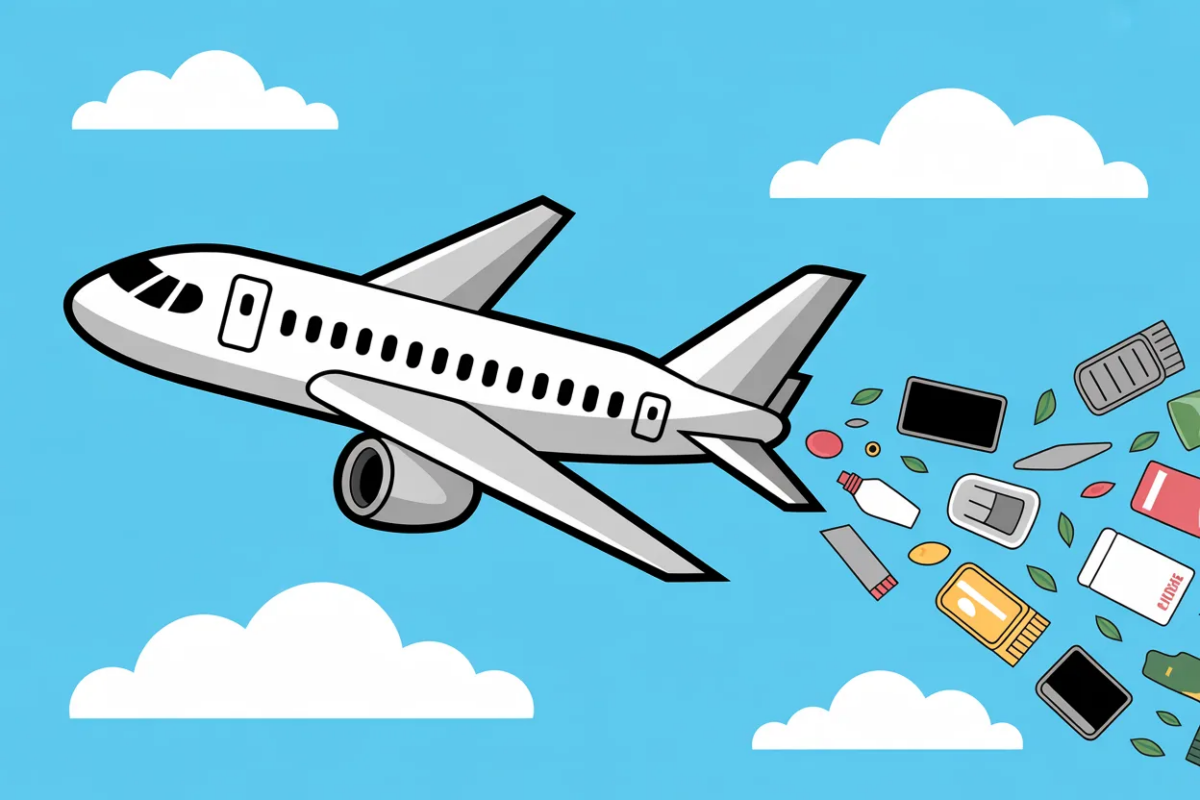
Phil Lockwood recently did something unusual on a flight from San Francisco to Manila. He tracked every single piece of waste his family of five generated during their 14 hours in the air.
The final tally: 17 plastic cups, five half-eaten sandwiches, three croissants (still in the plastic wrap), two brownies and five amenity kits — one unopened entirely, four torn open, poked at like a Happy Meal toy and abandoned.
Hmmm I don’t think 97% of passengers prefer their own devices, that sounds like a bogus statistic. We have devices and my kids are so excited when the planes have screens as they don’t use their battery life that way, and they get to discover new things. We especially look forward to the foreign films when we travel, as it often is interesting films that we don’t hear about otherwise, and the pairing to the entertainment systems to stream films on planes never works well.
Statistics wise, if I had to gauge based on what I see on planes, it typically is around 5% of passengers who use their own devices when a plane has TV screens, perhaps closer to 10% on short flights in the US (on ones with working screens, not the ones where you are forced to use your device which has more like 50% of people using their devices), and down to 2-3% on international flights. But I have never, ever, been on a flight where 97% of passengers use their own device, that is crazy talk. Not even on American where they send you tons of emails to bring your device, download the app, so on so forth, only around half of the passengers have devices out and the others are just nervously looking around…
The bigger problem though is the lack of working power charging on planes. Most planes when you plug an iPad into the USB slot will say the device is unsupported, and I would say that at least half of the planes I fly on don’t have working power plugs at the seats, maybe less than that, as I think out of my last 20 flights I was only able to charge my phone even on around 5 of those flights.
“The entire amenity model is built around the theater of generosity rather than actual value,” said Lockwood, a luxury travel broker. “Every item that goes untouched represents a cost baked into my fare.”
Call it forced frills — that moment when an airline hands you a “gift” you didn’t ask for, charges you for it in the ticket price, then watches you leave it on the floor for the cleaning crew.
Have we reached a tipping point where the extras in your airfare have become an expensive environmental and ergonomic liability? Passenger surveys indicate travelers are more digital-centric, yet airlines continue to double down on forced frills that few people actually use, like bulky seatback screens. (Research from in-flight technology provider Moment reveals that a staggering 97% of passengers now prefer using their own devices.)
Between the hidden weight of these monitors, the logistical nightmare of lukewarm meals, and the industry’s refusal to end this amenity theater, the cabin has become a clutter-magnet of services that inflate ticket prices while diminishing the travel experience. But it doesn’t have to be that way.
A landfill in the sky
For years, airlines have used amenity kits to distinguish flight classes and brand themselves. But for most passengers, the kits have become souvenirs of waste.
“Amenity kits feel less like curated gifts and more like standard-issue gear,” said Susan Sherren, founder of Couture Trips. “It’s the travel equivalent of being handed a kit on your first day of basic training.”
Syeda Sultana, the chief operating officer of a technology company, says she’s accumulated roughly 40 kits over her career as a frequent business traveler. The majority go directly into the seatback pocket. The ones she opens are “stuffed with a small toothbrush that I will use once and a lotion that I will never open.”
It doesn’t end well for these forced frills, says Joe Cronin, president of International Citizens Group, a medical insurance provider for expatriates.
“Those little bags with the eye mask and toothbrush end up in the trash or stuffed in a drawer at home,” he says.
Not every airline is backing away from the kits. Singapore Airlines says it’ll start rolling out new amenity kits in every cabin this month on flights longer than six hours. Economy passengers will get a collectible drawstring pouch with eyeshades, socks and a dental kit. In business class, the kit comes from the Swedish fragrance brand Byredo, with perfume, hand cream and lip balm.
The high cost of “free” entertainment
If you want to know why your basic economy ticket still feels expensive, look at the back of the seat in front of you.
Seatback screens are heavy and expensive to maintain. That’s why American Airlines started pulling them out of its narrowbody jets in 2017. It figured passengers would rather watch movies on their own phones and tablets. But in August, American reversed course. It says every seat on new Airbus and Boeing narrowbodies delivered from 2028 will have a screen, and it plans to retrofit older planes by the early 2030s. Manufacturers say the newer systems weigh less than the ones American removed. Panasonic Avionics, for example, claims its latest system is up to 30% lighter than previous versions.
There’s also a physical toll on passengers: On many aircraft, particularly Japanese carriers, the control boxes for these screens live under the seat in front of you, eating into the only floor space where a bag might otherwise go.
“That seatback screen is a relic,” said Runbo Li, a former executive for a large social media company. He’s had a front-row seat watching product teams bundle features to create perceived value even when users didn’t want half the bundle.
“In-flight entertainment systems exist because removing it feels like a downgrade on paper, even though nobody under 40 uses it.”
That’s true. Rochelle Kopp, a cross-cultural consultant who travels frequently between Japan and the United States, said she almost never uses the screen.
“I find it distracting and the light from it annoying,” says, adding, “They are often difficult to turn off.”
Not everyone agrees. Michael Taylor, a senior managing director at JD Power, noted that the screens “tend to distract passengers from slight arrival delays, slower speed of cabin service and even how the aircraft interior might be a little worn.”
Which, now that he puts it that way, might explain exactly why airlines keep them.
Lukewarm meals and unhealthy snacks
And then there’s the food.
Thomas Jeneby, a San Antonio plastic surgeon who flies constantly for conferences, said he’s never once eaten a packaged mid-flight meal. He says he’d rather grab something real at the airport, which is often less expensive.
“Between the smell in a pressurized cabin and the plastic waste it generates, it’s a lose-lose,” he says.
Even frequent flyers at the top of the loyalty ladder aren’t immune to the absurdity. Phyllis Stoller, a Diamond-level Delta flyer, boarded a flight from JFK to Mexico City in premium economy to find a handwritten note on her seat: “Thank you for being a Diamond traveler.”
She says she would have preferred a meal, but the airline wasn’t serving lunch on the flight.
Jordan von Haslow, a media executive who travels for work, says the amenities he’d cut are those that “create cost and clutter without meaningfully improving the passenger experience.” He’d rather have a slightly cheaper ticket, reliable charging and a little more legroom.
Is there a fix?
There’s a straightforward solution sitting right in front of the industry: Let passengers choose.
JetBlue gets it right. One of my readers flew JetBlue to Europe recently, and passengers could walk to the back of the plane and help themselves to snacks. Nothing placed in your space unless you chose it.
“Airlines could offer customizable amenity kits that let passengers select specific items at the time of booking,” Sherren says. “This would meet diverse traveler needs and show a commitment to customer care.”
But no. Legacy carriers are trapped in a branding war where stripping amenities looks like retreat, even when passengers keep signaling — through booking behavior, post-flight surveys and the kits they leave on the floor — that they’d rather have something else. Budget carriers figured this out years ago. The problem is that the data and the brand instinct are pointing in opposite directions.
“The airlines that win the next decade won’t be the ones offering the most stuff,” says Li, the former social media executive. “They’ll be the ones brave enough to offer less and pass the savings through.”
I’d go further. The amenity model is not only wasteful, but also condescending. Handing passengers a brownie or a branded eye mask whether they want them or not sends a message that travelers are seat numbers instead of people.
We’ve spent decades letting airlines treat us like toddlers, handing us little bags of plastic and trays of mystery meat to keep us quiet in their cramped seats.
Now we’re surrounded by trash. It’s time the airlines cleaned up their act.

Have a question about this story? Tell us what happened — we read every comment.
Join the conversation