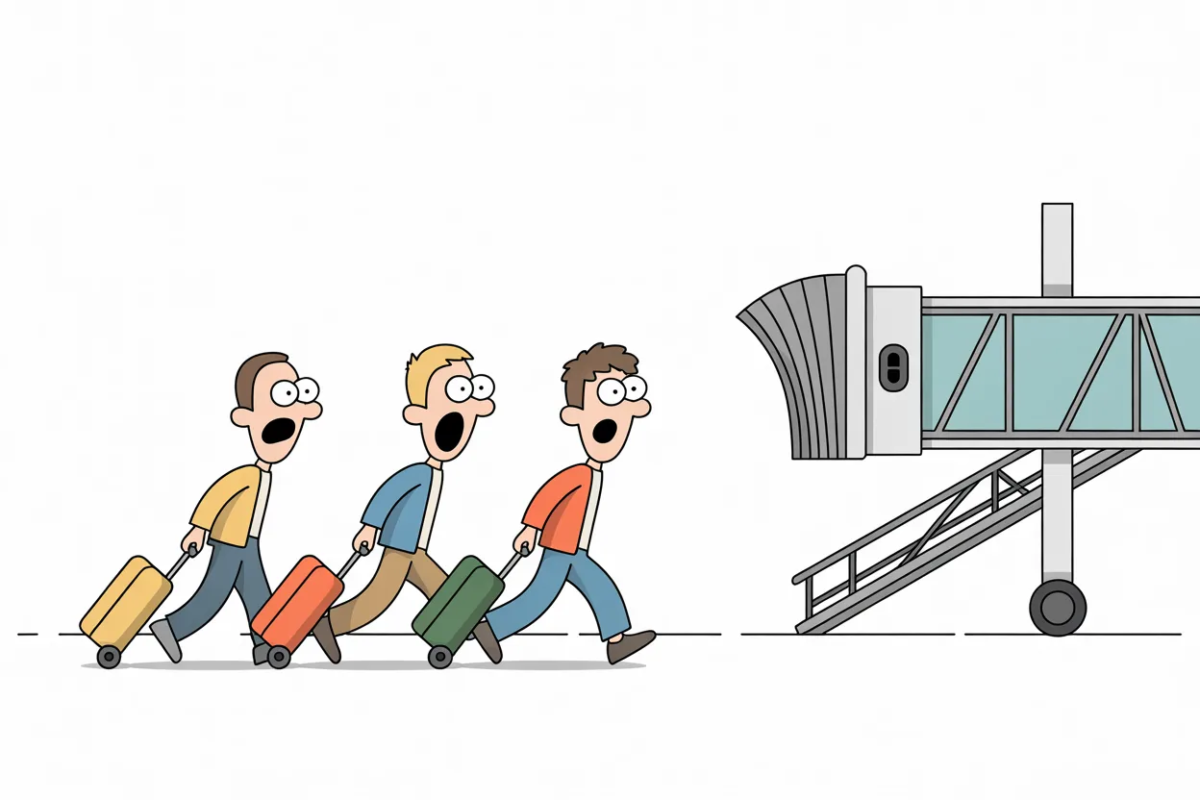
Admit it, boarding a plane is a contact sport. So is disembarking.
Passengers crowd the gate before their zone is called, wedge carry-ons into bins three rows ahead of their seats, and launch themselves into the aisle the instant the wheels touch down — all to save a few minutes.
On a recent flight from Queenstown, New Zealand, to Melbourne, Australia, I had a front row to the madness. An elderly man was so impatient to get off the plane that he started to push the woman in front of him. When she wouldn’t move because of the line of people in front of her, he yelled: “MOVE IT! [Expletive]!”
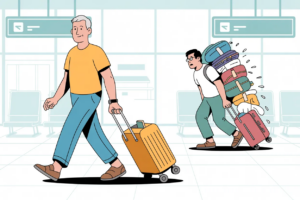
This holiday season, the scrum could get worse. Air travel is trending toward the busiest holiday season on record. It’s also the priciest in a decade. The average domestic round-trip Thanksgiving fare is $402, up 31% from last year. Hopper blames months of high jet fuel costs tied to the conflict in Iran. Those same fuel costs pushed most major U.S. airlines to raise checked bag fees by about $10 this spring. When checking a bag costs more, people drag more luggage onto the plane. That makes the fight for overhead bin space uglier.
A growing number of experienced air travelers have walked away from the whole performance. They board last. They deplane last. And they’re having a better time than anyone else on the plane.
Call them the last-on, last-off travelers.
The false urgency trap
The airline industry has spent decades conditioning passengers to treat boarding like an Olympic qualifying event: For example, priority boarding for elite members. The implicit message is that the first one on the plane wins.
But win what? Not a better seat. Southwest, the only major U.S. airline that let passengers choose seats after boarding, switched to assigned seating in January.
“The industry has sold priority boarding as a reward, which trains us to believe getting on first is winning,” said Dan Auerbach, clinical director with Associated Counsellors & Psychologists in Sydney. “It’s not. You’re entering a small metal tube earlier than you needed to and then are sitting there.
Auerbach and his team works with travel anxiety patients daily and says the urge to stand the moment the seatbelt sign goes on is simple biology.
“Flying puts most people in a low-grade freeze state for hours,” he explains. “Strapped in, unable to move, unable to control the environment. The instant the plane lands, the nervous system gets a green light to discharge activation it has been holding. Standing up, grabbing the bag, pushing into the aisle — it’s the body completing a stress response the cabin had been suppressing.”
In other words: everyone’s nervous system is telling them to move, all at once, in a space that fits about one person at a time.
What does that get you? Not much, says Tiana Pongs, an actress from Santa Monica, Calif., who travels frequently with checked luggage.
“Whether you’re the first or last off the plane, we’re all waiting at that carousel together anyway,” she says. “I’d rather spend that time as a relaxed human than a stressed-out passenger fighting for a spot in line.”
That’s the baggage-claim equalizer.
Exceptions for bin-space and connecting flights
There are legitimate reasons to board and disembark early, and they’re worth taking seriously. First, if you have a connecting flight, you don’t want to be too relaxed. Get to your next flight on time, please. And let the flight attendants know if you have a tight connection. They can help.
Then there’s the exception for overhead bin space. On full flights, especially now that most airlines charge $45 for a first checked bag, bins fill up fast. A late boarder risks gate-checking a carry-on — something most frequent travelers work hard to avoid.
Veruska Anconitano, a consultant who flies constantly for work, said the bin battle has real consequences.
“Business travelers, people carrying expensive equipment, or anyone who wants to avoid checking a bag at the last minute may feel pushed to board earlier than they actually want to,” she said. “The industry has created many of the conditions that make passengers behave this way in the first place.”
The workaround used by committed last-boarders: pack light enough to go under the seat, or get ahead of it by gate-checking voluntarily.
What “last-on/last-off” can do for your next flight
Refusing to be part of the stampede during boarding and disembarking can make a world of difference — to your sanity.
Faiz Ahmed, a business analyst based in New York, specializes in data analytics, so he ran the numbers.
“A typical narrow-body deplaning takes about 10 to 15 minutes from door open to last passenger off, the bags are not coming out for at least 15 to 20 minutes after that anyway, and standing hunched over in the aisle for 10 minutes saves you exactly nothing.”
Well, almost nothing. Jessica Wu, a Los Angeles physician who travels regularly for conferences, says there are physical benefits to staying put.
“Standing hunched under those overhead bins for 10 minutes straight is genuinely bad for your spine and neck,” she says.
Even the airline’s top customers — those who can board first — often choose to wait. Joey Rahimi, an American Airlines Executive Platinum member, boards last even when he’s holding a Group 1 boarding pass.
“The gate area is actually pleasant once the crowd clears,” he says.
When’s the last time someone called air travel “pleasant”?
How to opt out
If you want to try the last-on, last-off approach, the hardest part isn’t logistics — it’s ignoring the social pressure to join the herd. Here’s what experienced practitioners actually do:
Give yourself a task. The moment the wheels touch down, open something — a book, an email, a crossword. Auerbach recommends this for his anxiety patients: “The shift from ‘I have to wait’ to ‘I am choosing to wait’ is almost the whole trick, because it restores a sense of agency that the flight itself took away.”
Pick the right seat. Julie Wernau, co-founder of a culinary school in Trenton, Ga., books window seats near the back. “There’s no pressure from any seatmate to stand up when we land,” she says. By the time she looks up, the aisle is clear and the jetway bag line has moved.
Travel with a light carry-on only whenever possible. There’s no wait at the baggage claim area.
Ignore your zone. Just because they call your zone doesn’t mean you have to obediently line up. You have until the final call to get to the gate. Enjoy your last few moments of space and freedom of movement.
I’m last-on, last-off, too
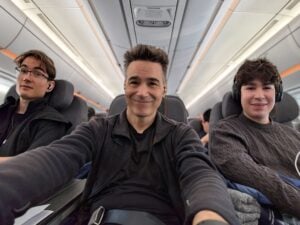
I’ve been a last-on, last-off traveler for years. I spend so many hours in airports that burning energy on a gate scrum feels like a game you’ll always lose. What I’ve noticed is that the people racing to board are never calmer when they land. They’ve just traded one form of stress for another.
The airline industry profits from the illusion of urgency. Priority boarding fees, early check-in upsells, expedited security lanes — these products only work if passengers believe that being first matters.
It rarely does.
The boarding gate isn’t a race. And the first person to stop running usually has the best trip.

Have a question about this story? Tell us what happened — we read every comment.
Join the conversation