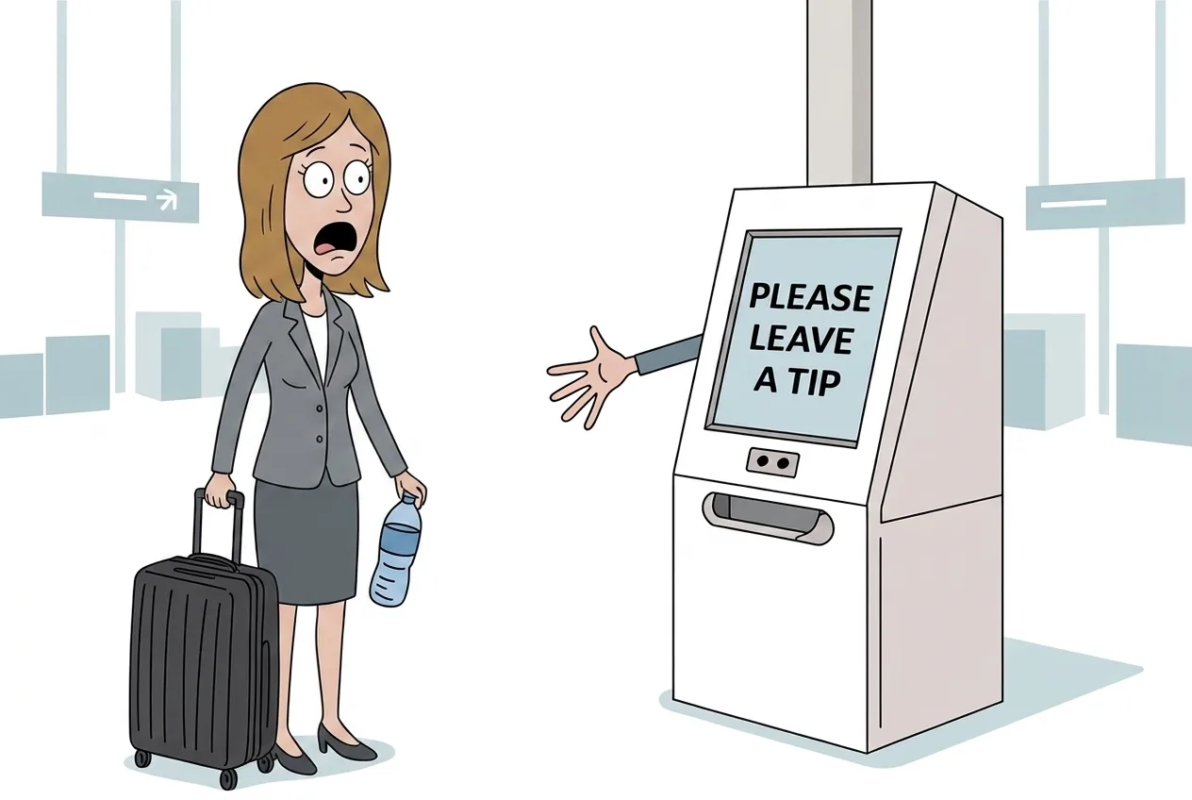
Cara Laban did a double-take when she bought a bottle of water at a tiny kiosk by the airport gate recently. Before she’d finished her transaction, the terminal asked if she wanted to tip 25% or 30%.
“I’m a tipper,” she says, “but I do not love tipping on a $7 bottle of water that I had to get myself from the fridge.”
A lot of travelers have been there. You’re staring at a demanding screen with a line forming behind you, wondering if you’re cheap for hitting ‘no tip.’
More than 2 in 5 Americans think the U.S. should ban tips, and most — 81% —t hink tipping has “gotten out of control.”
“Aggressive tipping prompts are becoming a growing source of frustration in travel and hospitality,” says WalletHub analyst Chip Lupo. “The concern consumers are expressing reflects a broader shift in how tipping is being used and perceived.”
Companies use screen design, preset percentages and the line behind you to pry loose tips, often before anyone has done anything for you. It’s become one of the more corrosive trends in travel.
And it’s gotten worse, to hear travelers talk about it. You’ll see it at hotel check-ins, airport kiosks, rideshares, lounge bars and self-service machines where nobody helped you.
It’s even spreading outside the country. Just last week, I took my sons out for pizza in Newtown, a suburb of Sydney. Before I finished placing the order on my phone, the restaurant’s app asked if I wanted to leave a 20% tip or a 30% tip. (Australia doesn’t have a tipping culture comparable to America’s, and tipping is entirely discretionary.)
The screen is doing the nudging now
In the old model, a tip was a human moment: Someone did something for you, you decided how much it was worth, and you paid. The pressure, if there was any, came from a person.
“What’s changed is not the behavior” says Anneliese Place, a former nightclub owner who has watched tipping culture shift from both sides of the transaction. “It’s the delivery. The pressure was human. A look, a moment, a sense of expectation. Now it’s built into the system. The screen is doing the nudging before any service is delivered.”
The screen isn’t neutral. Faiz Ahmed, an expert on payment infrastructure, says the default tip flow on most kiosks is set to whatever maximizes the business’s revenue — not what’s fair to the worker or the customer.
“The terminal makers know exactly what conversion lift each layout produces,” Ahmed says. “That’s why the buttons keep getting larger, the percentages keep climbing, and the ‘no tip’ option keeps moving to a less prominent position.”
And the workers? Often they see only a fraction of it, or nothing at all.
Should you tip before you get service?
Andrew Cullison, executive director of the Cincinnati Ethics Center and a philosophy professor at the University of Cincinnati, says people have three moral objections to pre-loaded tip prompts.
The first: tipping was designed to reward service after the fact, and to create an incentive for the worker to do well. Pre-loaded prompts destroy both functions.
“When I was recently at a deli and was asked to tip before anyone had touched the bread, I hadn’t seen whether they got the order right,” Cullison says. “Tipping in advance works against both the reward and the incentive that justified the practice in the first place.”
His second objection is coercion, in two distinct forms. One is the social pressure of a public screen with a line behind you. The other is more concrete: If you decline a tip before your sandwich is made, the person who hasn’t yet made it may know you declined.
“You may reasonably worry that declining will affect the service you receive,” Cullison says. “That is a form of coercion that traditional tipping never imposed on the customer.”
The third is what he calls the poisoning of the well. When travelers get burned by enough bad prompts, they start declining across the board — including in situations where a tip is genuinely warranted. Wait staff at sit-down restaurants, people paid a subminimum cash wage who depend on gratuities end up paying for the sins of a kiosk vendor.
“These prompts are designed to make declining feel antisocial,” Cullison says. “Recognizing that is itself useful.”
One government has already stepped in. This summer, India’s Ministry of Road Transport and Highways ordered ride-hailing apps to remove tip prompts that appear before or during a trip.
Under the country’s Motor Vehicle Aggregator Guidelines, an app can offer a tip button only after the ride ends. The driver gets the full amount, with no cut for the platform. The ministry was reacting to apps that offered an “advance tip” or hinted that a tip might get you a car faster.
The rule covers only cab apps, and only in India. But it draws the line where Cullison does: after the service, not before.
How to say no to a tip screen without guilt
I’ve been on the receiving end of these prompts more times than I can count. Experts offered a few ways to push back.
Slow down. Justin Carter, an assistant professor of management at the University of North Alabama, says to treat every tip prompt like any other purchase decision. “Slow down, read the screen, and choose the amount that matches the service actually provided,” Carter says. “The villains in that situation are poor design and lack of transparency, not the customer.”
Ask one question before you tap. Gregory Lee, the chief operating officer for an apartment rental site in Boston, offers an easy test: “Did a specific human just do something tangible for me?” If the honest answer is no, you can decline without feeling cheap.
Watch for pre-service timing. James Kastelein, who runs a service business in Richmond, Va., says to watch the timing. A legitimate gratuity prompt comes after a service is rendered, not before. If the kiosk is asking for 30% before anyone has lifted a finger, that’s a company using social pressure to collect revenue.
Tip workers directly when you’re unsure. Laban carries small bills specifically for this. If you’re not sure the platform payment reaches the person who helped you, cash still works. It’s the surest way to get the money into the right hands.
Does guilt tipping hurt workers who earn tips?
Guilt tips erode trust in a way that’s hard to rebuild. When every checkout becomes a small trust test, the fatigue builds up. Eventually, people might just start declining everything, including at restaurants where servers count on tips.
Laban, the woman confronted with the $7 water bottle, has an insider perspective. She’s the founder of an online travel preparation tool and is herself a former restaurant server.
“If I had great service or enjoyed my tour experience, and I am being prompted to tip on a platform or a computer, I will ask the service worker or the tour guide if they get the tip directly,” she says. “If they get all of it, I’ll tip. If not, I will tip them cash.”
But a gratuity for a bottle of water? No thanks.
“I did not feel like a monster for not tipping,” she adds.
The companies running these schemes are, as Cullison says, poisoning the well for their own staff.
Tip generously when someone earns it. Tip workers directly when you’re not sure the money reaches them. And when a kiosk asks you for 30% before it’s done anything for you, don’t feel like a villain for saying no.

Have a question about this story? Tell us what happened — we read every comment.
Join the conversation