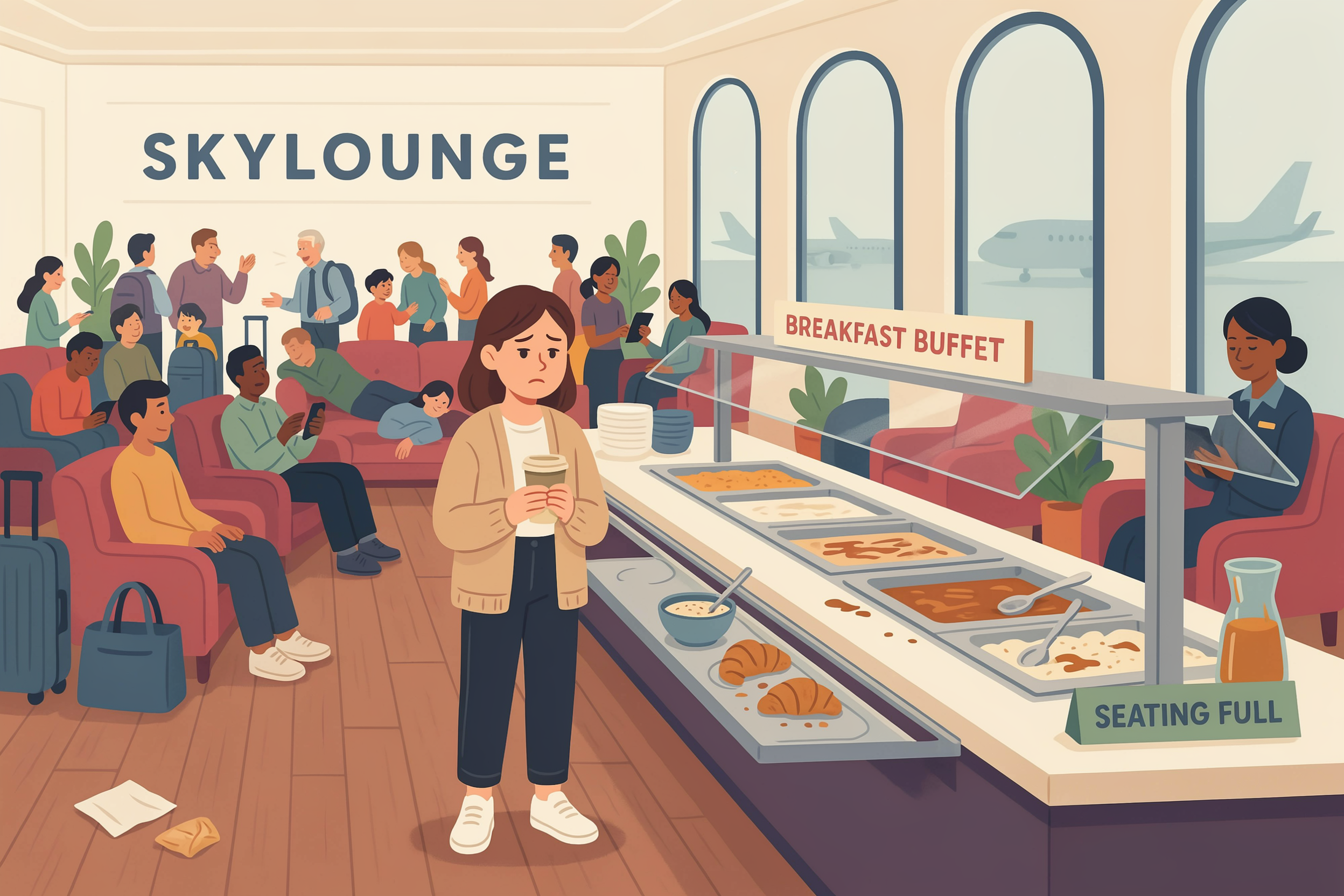
Illustration of a worried young traveler sitting inside an airport as smoke, flames, and panicked crowds appear outside the windows.

When your vacation turns dangerous: How do you know it’s time to leave?

Kate McCulley, a journalist based in Prague, knew it was time to leave Madagascar. Flights were getting canceled, protests had moved outside her hotel in Antananarivo, and the country was on the verge of a military coup. The police blanketed the neighborhood in tear gas. After several days of trying, she finally caught a flight to Réunion. Most travelers face a much harder version of her call. After months of planning and thousands of dollars spent, deciding whether to cut a vacation short when conditions shift is rarely simple. Civil unrest, a natural disaster, a sudden spike in crime, or a slow drift in local sentiment can each push a manageable risk toward a real threat. Government advisories often lag behind reality on the ground, tour operators have an interest in downplaying risk, and standard travel insurance generally will not cover a trip cut short on fear alone. There is no algorithm for the stay-or-leave decision, but security professionals point to clear early triggers that separate a manageable situation from a dangerous one, if travelers know what to watch for.

Illustration of a worried man on the phone holding a credit card while a concert crowd watches performers on stage, representing a StubHub ticket refund dispute.

This StubHub rep’s “help” with Coldplay tickets cost me $3,000!

Paul Avron’s daughter bought three Coldplay tickets at Hard Rock Stadium in Miami for $1,027, nine months before the show, as a birthday gift for her best friend and the friend’s dad. On the day of the concert, the StubHub app said the tickets were being released, but they never appeared. With the show already starting, the family called StubHub in a panic and asked for the tickets or replacements so the group could get in. The last representative refused to provide replacement tickets and said they had to buy new ones, promising StubHub would refund the original $1,027. The rep said he saw three tickets for just $1 more than the original purchase and sent a link. The tickets were actually $1,000 each, and StubHub charged the credit card $3,000. The family disputed the charge with their credit card company and contacted StubHub directly, but both representatives said they would not credit the account. The family never accepted or used the expensive tickets and never attended the concert. StubHub’s FanProtect Guarantee promises valid tickets or your money back, and says StubHub will find comparable replacement tickets when possible.

Illustration of an Aer Lingus representative offering a voucher to a frustrated customer checking his watch, with the caption “One year later…”

Aer Lingus issued her voucher but ghosted her husband for over a year

After a death in the family, Beatrijs Albarran and her husband Jorge had to cancel their Aer Lingus flights. The airline issued their refunds as vouchers, $938 for her and $925 for him, and emailed that both had been processed. But when Beatrijs called the next month to book a new trip, an agent told her Jorge’s voucher was never actually issued. The couple, who live in Buffalo, New York, wanted to fly from Toronto to Scotland because the fares are better, and asked whether the vouchers could be reissued in Canadian dollars. Beatrijs received hers in U.S. dollars within a reasonable time. Jorge’s never arrived. For more than a year she called repeatedly, hearing the same response that a supervisor was working on it, while automated emails said the case was under review. More than 15 months after Aer Lingus said it processed the voucher, it still had not appeared. Under Aer Lingus policy, vouchers are issued in the same currency as the original booking, so no conversion was needed to book from a Canadian airport, and the Department of Transportation requires airlines to process refund and credit requests promptly.

An angry airline passenger stands with a suitcase while holding a $10 voucher after a flight delay.

The delay tax: Why your airline voucher barely covers your expenses anymore 

When a flight is delayed or canceled, airlines cover only what they call duty of care: a meal voucher, sometimes a hotel, or a refund if the flight is canceled. Angela Justice received a $10 voucher after her Boston to Chicago flight was canceled. The real cost, the delay tax, is far larger. It includes nonrefundable hotels travelers cannot reach, lost wages, child care that keeps ticking, and the replacement flights passengers must book themselves when the airline’s rescheduling timeline proves useless. Airlines calculate compensation based on what it costs them to reschedule a flight, not what it costs the traveler to miss the reason they flew in the first place. The official story is that duty of care solves the problem and the Department of Transportation signs off. But the law was written in a different era, when travel was simpler and airlines were more generous, and regulators have not caught up now that delays are chronic and carriers watch every penny.

Fear of travel is at a high, but the data tells a different story. Here's why your summer vacation is still a safe bet, from peace rankings to airline risk.

No, your summer vacation isn’t going to kill you

Fear of travel is running high this summer. A reader named Cindy Smith nearly canceled a Danube river cruise and a week in Croatia after reading headlines about a cruise hantavirus outbreak and crew arrests. She is not alone. In a recent Global Rescue survey, less than 1 percent of respondents said their concerns about personal safety abroad had eased since last year, while 56 percent said they felt more concerned. Travelers cite three recurring fears: airlines collapsing mid-trip, dangerous conditions abroad, and anti-American sentiment. Yet the major U.S. carriers such as Delta, United, American, and Southwest remain profitable, and a conflict on one side of a continent does not make the other side unsafe.

Simple hand-drawn Bauhaus-inspired minimalist illustration on a white background showing a black line-drawing of an airplane taking off on the upper left and a small black line-drawing of a car on the lower right, separated by a single bold red diagonal line running corner to corner, symbolizing the widening divide between affluent air travelers spending more per trip and budget-conscious travelers priced out of summer vacations this year

The summer travel divide: How to find affordable vacations this year

Summer travel intent has hit its lowest point since the pandemic. Deloitte’s latest summer travel survey found only 45 percent of travelers plan a summer vacation with paid lodging this year, the lowest figure in six years. Travel intent fell across every income bracket, but the drop among households earning under $100,000 was twice as steep as the decline among middle- and high-income earners, an 8-point drop versus 4 points each. The travelers still going plan to spend $4,069 on their summer vacations, up 17 percent from last year. Deloitte’s broader 2026 outlook calls this a bifurcation of standard and luxury travel and frames competition for the high-spending traveler as one of the year’s defining trends. Travelers earning between $100,000 and $199,000 show the biggest booking gap, with 37 percent fully booked versus 45 percent last year, leaving a large amount of unsold late-May inventory that revenue managers are aware of.

Architect Anders Lendager with a graying beard and dark bomber jacket gesturing with both hands as he speaks in front of his timber-clad TRÆ office building in the Sydhavnen port district of Aarhus, Denmark, with the wooden facade and large windows visible on the left and modern high-rise buildings, a construction crane, and a freight truck in the background under an overcast sky

Wooden skyscrapers, next-level recycling: How Aarhus wants to become one of the most sustainable cities in the world

Aarhus is often described as Denmark’s second city, but it is quietly trying to become something more difficult to define. Behind its cafés, port cranes, hotels and waterfront developments is a city testing how far sustainability can be pushed into ordinary urban life. Its energy system has already moved away from coal, its heating network is being reshaped by geothermal plans, and even its waste, cruise terminals and new buildings tell a larger story about how climate ambition works when it leaves policy documents and enters daily infrastructure. From the Port of Aarhus to the Sydhavnen district, from Randers’ rainwater systems to ecolabelled hotels and low-impact stays near Mols Bjerge National Park, the region offers a closer look at what a greener city can become when design, energy, tourism and waste management all start moving in the same direction.

Editorial cartoon of a disappointed woman with shoulder-length hair resting her chin on her hand while holding up a smartphone showing the orange StubHub app, seated at a table against a pink wall with a vintage-style concert poster for The Lumineers hanging on the wall behind her, illustrating a frustrated concertgoer who received the wrong tickets and struggled to get a refund through StubHub's confusing return policy

Help! StubHub’s confusing ticket return policy cost me $1,176

Sharon McMonagle paid $1,176 for four club section tickets to a Lumineers concert through StubHub. The confirmation email included no seat numbers, and the day before the show StubHub sent tickets for a completely different section with no club access. StubHub asked her to accept the wrong tickets and transfer them back, which she feared would lock her into ownership. An agent told her to send a screenshot proving she had not accepted the tickets. After 45 days, StubHub said she would receive nothing because she had not returned the tickets through Ticketmaster, tickets she never accepted in the first place. StubHub advertises a FanProtect Guarantee promising that buyers who do not receive the tickets they ordered will get comparable replacements or a full refund.

Minimalist editorial cartoon of a frustrated couple sitting back-to-back on a single gray suitcase in an airport terminal with their heads bowed, both staring at their smartphones with downcast expressions, surrounded by blurred information board signs in the background, illustrating a Cleveland couple's stressful return trip from Greece after Delta and Sky Express cascading booking errors forced them to pay for a new $435 ticket and recheck their luggage in Athens

An agent error turns a simple return trip into a costly odyssey. Will Delta fix it?

Robert Kempke and his wife flew from Cleveland to Athens with a return through Thessaloniki on Sky Express, a regional carrier booked through Delta. Their online check-in for the Sky Express flight was blocked because of a 185 euro balance linked to a duplicate third passenger using Kempke’s name. Sky Express refused to fix the error and told them Delta had to correct it. The Delta agent canceled and rebooked the Sky Express segment, which collapsed the entire return itinerary including the Athens to Cleveland flight. The Kempkes paid $435 for a new Aegean Air ticket to Athens, retrieved and rechecked their luggage, and rebooked their U.S. return. Delta initially promised a refund plus 12 euros for seat assignments, then denied the claim. Under U.S. Department of Transportation rules, passengers are entitled to automatic and prompt refunds for flights canceled by the airline. EU Regulation 261/2004 applies to flights within or departing the European Union.