
in this commentary
- A traveler stood in two lines to drop one checked bag, fought a kiosk that kept rejecting it, and watched three nearby employees chat and hug rather than help. It is a small scene that captures a bigger shift: the unpaid work of do-it-yourself travel, and being left on your own when the machine fails.
- From frozen check-in apps to help centers that loop endlessly, more of travel’s routine tasks have been handed to the traveler, and the piece asks why a system sold as convenience so often feels like abandonment when something breaks.
- There is a reason companies keep pushing the DIY button, and there is a case that they are trading something valuable to do it. The commentary lays out both, and what a traveler can actually do about self-service fatigue, without pretending the counter line is always the easy answer.
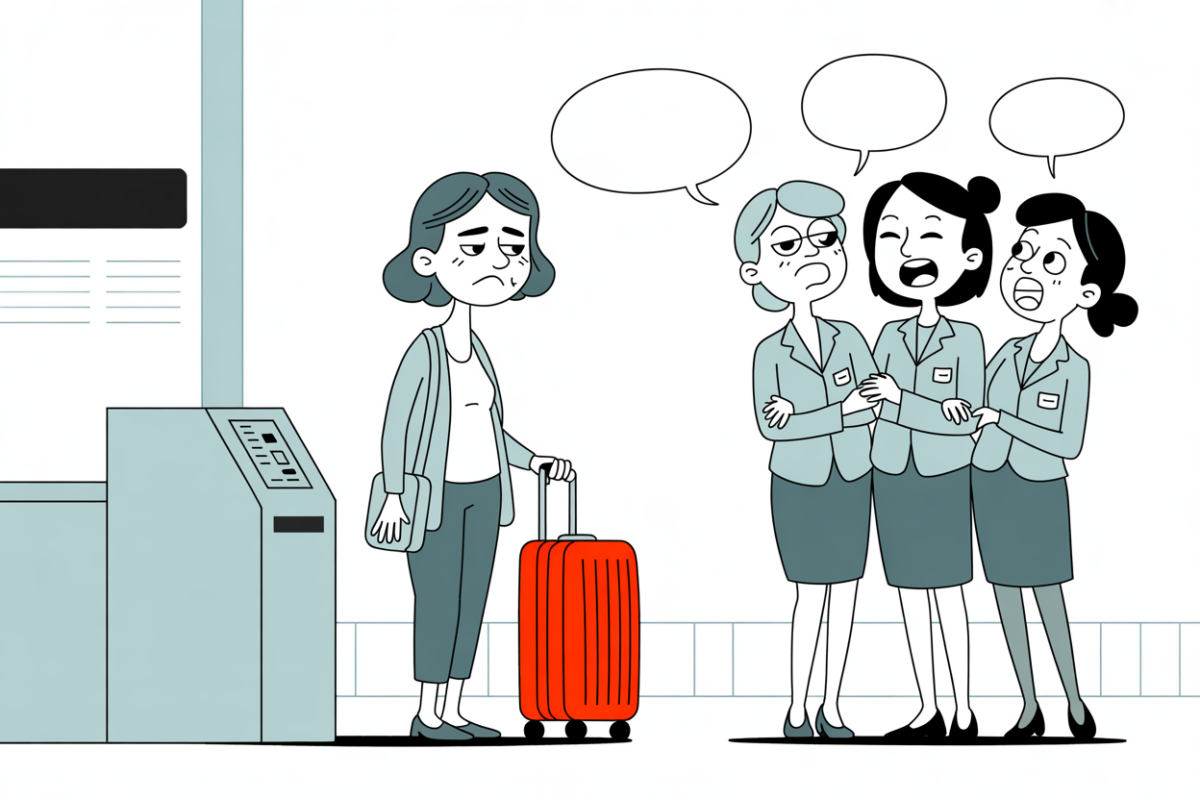
Judy Williams’ recent flight from Seattle to Billings, Mont., was a painful lesson in self-service fatigue. She stood in two lines at the airport to drop a single checked bag. Then the machine rejected it — again and again.
The insult wasn’t the glitchy kiosk. It was the three employees nearby who ignored her.
“They were engaged in a personal conversation and hugging,” says Williams, an attorney from Billings.
That’s the reality of DIY travel: You do the unpaid work. When the system fails, you’re on your own.
Williams finally got the machine to ingest her luggage. She complained.
“They apologized,” she says. “Big deal.”
But it is a big deal.
The emotional labor of DIY travel
“Self-service technology was never meant to replace human support,” says Mario Matulich, president of the Customer Management Practice, a consulting firm. “It was meant to enhance it. But in travel, we’re seeing a widening gap between the intention and the reality.”
Matulich says when you are already stressed by delays and weather, every extra task becomes emotional labor.
“Failed, insufficient, or ineffective self-service causes fatigue,” Matulich told me. “At a certain point, that convenience starts to feel like abandonment.”
As travel gets more stressful, “our cognitive load can easily become overwhelmed,” says Thomas Plante, a psychology professor at Santa Clara University.
For those of us who are comfortable with technology (I count myself in that group, and do realize that there are others who do not), self service options can be a great time saver. I remember the old days of standing in line for long periods at the airport to obtain a boarding pass; nowadays I check in on the airline app and head directly to security when I arrive at the airport. I rarely check a bag, but if I do, I have no problem using the self service machines.
If you want to stand in line to wait for (and perhaps pay for) a human, that is your choice of course, but technology is the future, and people should be encouraged to embrace it wherever they can.
Same at the supermarket, I am the one breezing through the self checkout, not waiting in the long line for a manned checkout.
Read more insightful reader feedback. See all comments.
When the app freezes, you’re stranded
If the technology works, fine. But when it fails and no human is there to save you, you’re out of luck.
Joachim Rodriguez y Romero recently downloaded his airline’s app to check in early. But when he tried, the screen froze.
“It gave me a non-specific error message,” says Romero, an artist who lives in Passau, Germany. “I lost the ability to secure a suitable seat, and I was afraid I might not be able to board.”
His fears weren’t entirely unjustified. His airline allowed him to board — after he paid a $35 fee for using a human to check in.
“The staff did not respond to my claim that the mobile app had a glitch,” he says,
Justin Robbins, a customer experience analyst, recently hit a similar wall with Uber. After finding a duplicate tip charge, he tried to resolve it on the app.
“The help center looped endlessly,” he says. “When the self-service broke, the system transferred responsibility without providing a solution.”
Uber eventually told him it couldn’t connect him to a human.
One task encapsulates this new world of unpaid labor: the self-service baggage tag.
Forget the existential dread of a cancelled flight; nothing prepares you for the cognitive load of a thin, adhesive strip of paper. You stand in the terminal, the clock ticking, staring at a paper-folding puzzle. Which end peels? Which side faces out? Why is the bar code sticking to my thumb?
It’s a moment of low-stakes panic that raises your blood pressure. A process meant for efficiency has outsourced a five-second human task into two minutes of uncompensated agony.
Why are they doing this to us?
If travelers hate this, why do companies keep pushing the “DIY” button?
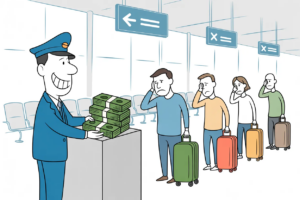
“Money. Always follow the money,” says Christine Landis, a former fintech CEO and frequent traveler. “People are the most expensive line item on a P&L. Cut your reliance on people and you typically make more money.”
It is a margin play. But experts warn that companies are trading long-term loyalty for short-term savings.
“The risk isn’t just fatigue,” says Geoff Ryskamp, an executive advisor for hospitality at the customer experience systems company Medallia. “It’s losing customers. Forty percent of customers who encounter an issue on a website or app that they can’t resolve during a purchase will just switch to a competitor.”
It isn’t always greed. When I checked into a Fiji resort, a cheerful associate directed me to download the hotel’s app. I installed it and never used it. Why does a hotel need an app when its keys are attached to large river rocks?
Later, I checked into a rival resort on the other side of the island. It also had an app, but there, everything was automated— a DIY arms race.
How to beat self-service fatigue
- Hire a pro. Pay a travel advisor. As Amy Siegal notes, “you want to be a passenger, not a planner.” An agent can help you bypass at least some of the DIY nonsense.
- Refuse to play. Do what Patricia Haubner of Vermont does: Refuse to use the apps. Go to the counter. Make a human check you in. (It may cost extra, but it might be worth it.)
- Vote with your wallet. Walk away from bad self-service. Switch to full-service airlines like Emirates or fly Southwest for human interaction without the price tag.
“I think self-service fatigue from the traveler comes back to one key point,” says Jacqueline Dobson, President of The Vacation Group. “As much as convenience in travel is key, people ultimately want to be served by a real person.”
Fine, make us do it ourselves, but …
Here’s the deal: If you force me to download an app and check my own luggage, you’re asking me to do your job. So pay me. If I save the airline an employee’s salary, give me a cheaper ticket.
Until then, I’ll be the guy standing at the counter, waiting for a human. And if I see them hugging instead of helping, you can bet I’ll have something to say about it.
Your voice matters
Airlines, hotels, and apps keep shifting more of the work onto travelers. We want to know how you feel about doing the company’s job.
- Where is your personal limit with self-service travel: check-in kiosks, self-tagging bags, app-only support? What crosses the line from convenient to insulting?
- Have you ever been stranded when an app or kiosk failed and no employee would help? What happened?
- If a company saves money by making you do the work, should it be required to pass some of that saving back to you in a lower price?
What to know about self-service fatigue in travel
As airlines, hotels, and apps push more tasks onto travelers, the do-it-yourself experience can wear people down. Here is what travelers ask most.
What is self-service fatigue?
It is the exhaustion and frustration that build up when travelers are asked to do more and more tasks themselves, from checking in on an app to tagging their own bags, often with little or no human help when something goes wrong. Experts describe it as convenience that starts to feel like abandonment once the technology fails.
Why do travel companies push self-service?
Mainly cost. Staff are one of the most expensive items on a company’s books, so shifting work to travelers through kiosks and apps can lower expenses and raise margins. Critics argue this trades long-term customer loyalty for short-term savings.
What happens when the technology fails and no one helps?
Travelers can be left stranded. People have reported frozen check-in apps, kiosks that reject bags, and help centers that loop endlessly without reaching a human. In some cases a traveler ends up paying an extra fee for human help, even when a company’s own app was the thing that glitched.
Can I be charged for using a human instead of the app?
Sometimes, yes. Some airlines charge a fee for checking in at the counter rather than online or through the app. That can feel especially unfair when the app failed in the first place, so it is worth documenting any glitch in case you want to dispute the charge.
How can I reduce self-service fatigue when I travel?
A few strategies help: use a travel advisor so you can be a passenger rather than a planner, go to the counter for a human when it matters even if it costs a little more, and favor companies known for real human service. Documenting failures also helps if you need to complain or dispute a fee.
Does self-service fatigue actually cost companies customers?
Experts say it can. Customer-experience specialists warn that a meaningful share of customers who hit an unresolved problem on a website or app during a purchase will simply switch to a competitor, which means poor self-service is not just annoying, it can drive people away.
Is all travel automation bad?
No. Self-service technology can genuinely speed things up when it works and when human help is still available as a backup. The problem is not automation itself but automation that removes the human option entirely, so travelers have nowhere to turn when it fails. For more consumer travel guidance, see Elliott Advocacy’s travel coverage.

Have a question about this story? Tell us what happened — we read every comment.
Join the conversation