When Whitney Dailide ordered a $168 playground slide on Target.com, she figured she was buying it directly from Target. So when she decided to return it, she did what any reasonable shopper would do: She took it back to her local Target.
The store turned her away. The reason? She was three days past her return date.
“That’s a lot of money for me,” she says.
Target has a 90-day return policy for most of the items it sells. But Dailide hadn’t bought the slide from Target. Target’s website sold it to her via a third party, and Dailide didn’t have a clue. If she’d only checked the terms under a “Shipping & Returns” heading. (Ever read one? Me neither.)
Call it the shadow return policy. You don’t see it until you’re at the customer service counter with a box in your arms and a receipt in your hand.
Shadow return policies are everywhere this holiday season. You can find mail-in fees, restocking charges, and carve-outs for marketplace sellers. Most shoppers find out about them after they’ve paid. That’s wrong.
Every merchant should show you its return policy clearly before you buy, on the product page and again at checkout — every fee, every extra and every third-party seller’s terms. And while we’re at it, let’s standardize a minimum 30-day return window.
The fine print keeps getting finer
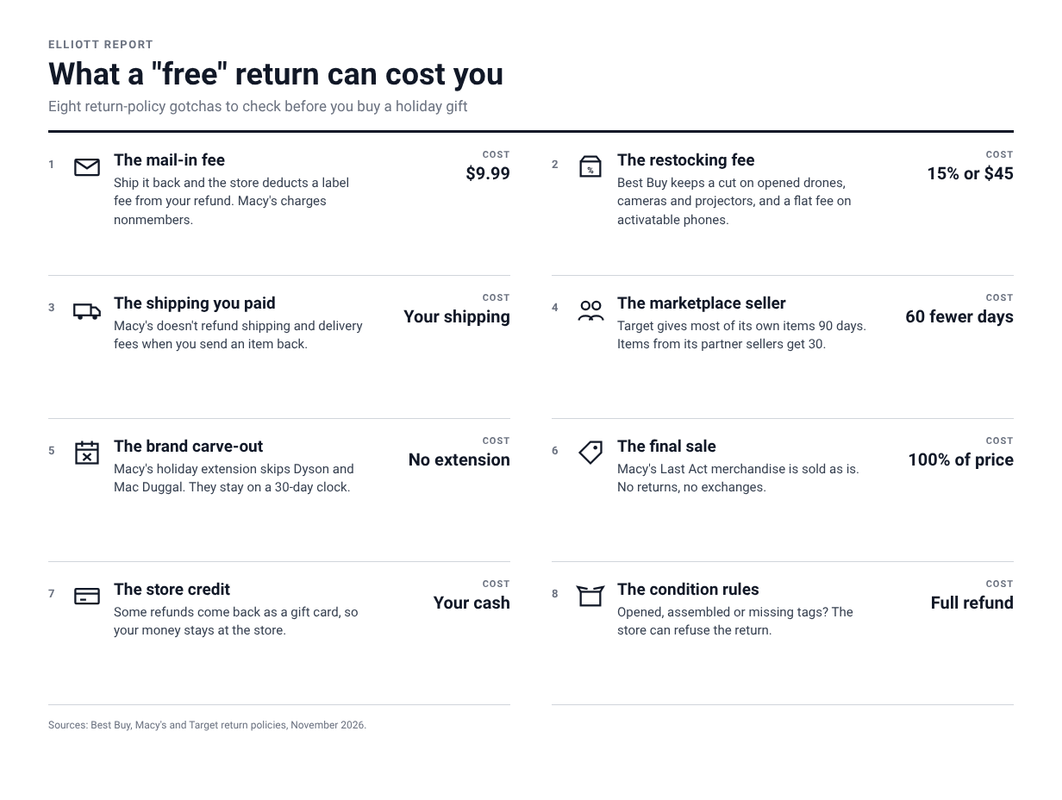
Look at Macy’s. Most holiday purchases are returnable until Jan. 31, 2027. Mail one back, though, and the store deducts a $9.99 shipping fee from your refund unless you belong to its Star Rewards program.
Amazon will take back most items bought between Nov. 1 and Dec. 31 until Jan. 31, 2027. It has reportedly told sellers the holiday window will now apply every year. Apple products have a shorter deadline of Jan. 15.
The charges keep increasing, too. In Britain, 59% of retailers in the network of returns company ZigZag expect to charge for returns this holiday season, up from 54% two years ago. In September, amazon.de reportedly cut its return window from 30 days to 14 for furniture, beauty products, luggage and mobile electronics. Don’t be surprised if American stores follow.
Sure, returns are expensive. The National Retail Federation estimates that returns cost U.S. retailers almost $890 billion a year. Some customers abuse liberal policies, buying a dress for a party and returning it the next morning.
Of course, a business has every right to set its own rules. But shouldn’t it show a return policy as part of the sale price? If a $9.99 fee or a 14-day window applies to your purchase, why not say so?
Two states have already taken action against shadow return policies
New York requires retailers, including online sellers, to post their refund policies prominently. The disclosure has to cover any time limit, whether you’ll get cash or store credit, and any fees, such as a restocking charge. A store that skips this step owes you a refund or credit on unused merchandise for up to 30 days.
California has a similar rule. A store that won’t give a full refund or exchange within seven days has to post its policy at the register, at the entrance or on the item. If it doesn’t, you can return the item with proof of purchase for a full refund within one month.
Both states have a 30-day return period. That’s a good start. I think we might all benefit from a national standard that also covers marketplace sellers. Also, if a third party sells an item on a retailer’s website, the checkout page should say it: “Sold by XYZ Co. Returns accepted for 30 days.”
A soft landing at the bottom of the slide
Dailide did everything right after Target turned her away. Two employees told her to get the seller’s approval in writing. She got it and forwarded it to Target. Then a Target representative told her the seller hadn’t approved the return. It had.
I contacted Target on her behalf. Target gave her a $168 gift card and told her to keep the slide.
Dailide shouldn’t have needed a consumer advocate to return a product. She deserved to see the seller’s deadline when she checked out. This holiday season, so do you.
Resolve it yourself
Stuck with a complaint? Build your path to a fix.
Answer two quick questions and get a step-by-step plan tailored to your situation.
Your plan

Have a question about this story? Tell us what happened — we read every comment.
Join the conversation