Kishore Bitra thought he’d found the perfect hotel in Hershey, Pa. The detailed customer reviews praised the property’s “upscale” amenities and “attentive” service. But when Bitra checked into his room, he found something entirely different: a broken air conditioner, dirty sheets, and a property in a state of disrepair.
Then he took a closer look at the user comments and noticed that they were all posted the same week. To the average guest, that might not seem strange. But to Bitra, an engineer who works for the city of Baltimore, it raised a red flag.
“These aren’t real people,” he concluded. “They’re AI agents managed by reputation management firms.”
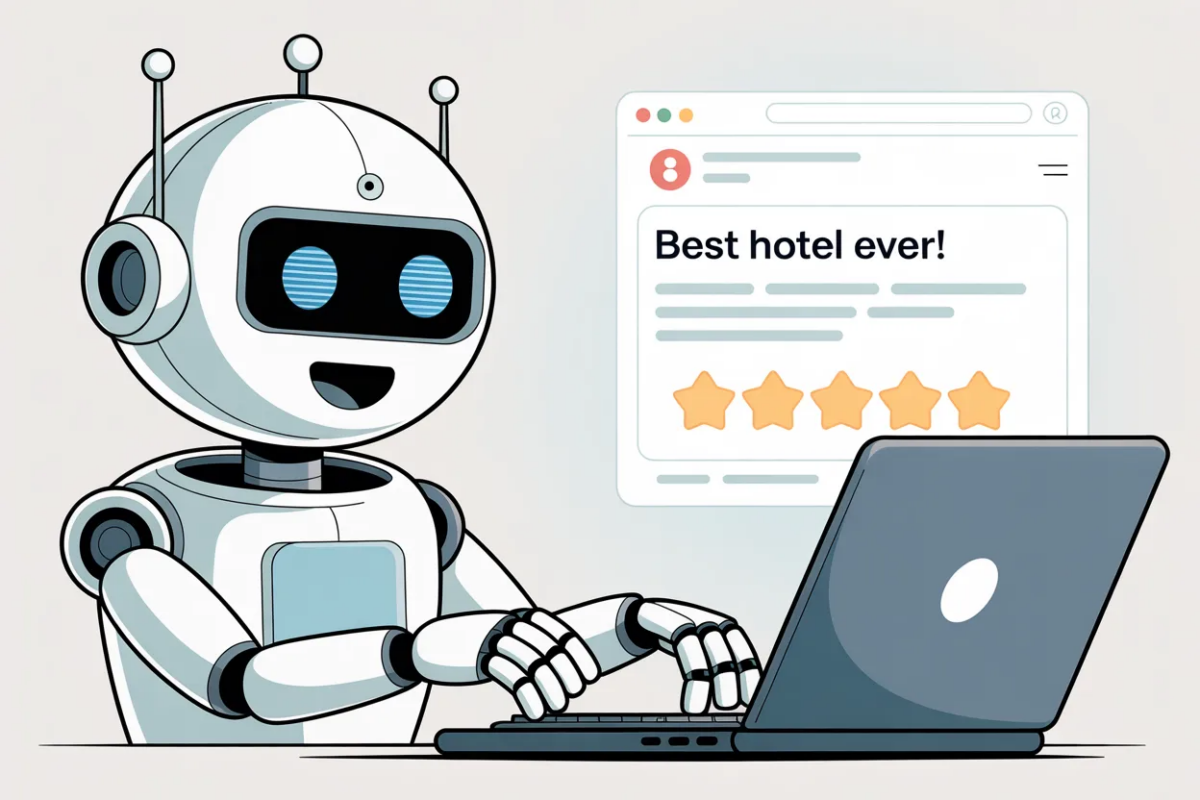
More than 20% of luxury hotel reviews were AI-generated in 2025, according to Originality.ai, a content verification tool that detects AI-generated text. That’s double the rate in 2022. And the fakes skew flattering: 57% of them carried five stars. A recent survey by WalletHub shows that 83% of Americans are concerned about being manipulated by AI.
“It’s become very difficult to sort the actual customer reviews from the auto-generated ones,” says Joe Cronin, president of International Citizens Insurance.
Crowd sourced reviews made the internet useful. AI turns reviews into false sourced lies. When ignoring five and one star reviews renders bot reviewing useless, the bots will be writing fours and twos, until only three star reviews are trusted, until they write those too.
I might just as well stay home, except the staff is nasty to me when I complain. Two stars.
Beware of travel slop
I’ve been tracking travel scams for decades, but what we’re seeing now is alarming. It’s a tidal wave of travel slop that uses generative AI to create a filtered reality. Dumpy motels can pass themselves off as Ritz-Carltons. Airlines that hate their customers can masquerade as customer-focused Pan Am in the 1960s.
“The industry is using generative AI to flood the zone with synthetic praise and bury legitimate complaints,” says Jack Charman, a private investigator who leads a London intelligence firm.
The goal: Make sure consumers never see any negative feedback about the travel product.
Companies use AI to remove blemishes from photos. Power poles and brick walls get one-click deletion from an Airbnb listing. Crowded resort beaches get Photoshopped until they look abandoned and pristine again. Travel companies create AI sock puppets—fake digital identities with credible histories that post across multiple platforms to drown out real voices.
One-third of adults in a recent study couldn’t tell the difference between an AI-generated image and a real one.
“AI now allows companies to influence search results, automate reassuring responses, and control the flow of information in ways that make it harder for travelers to understand what the experience is really like,” says WalletHub analyst Chip Lupo. “AI helps travel providers charge consumers more as well, from the booking price to how much you pay for incidentals after the fact.”
These are the new tools of deception
Here’s how some in the travel industry may be using AI to manufacture trust at scale.
“We’ve moved past simple fake reviews generated by content mills,” says Rafay Baloch, CEO and founder of REDSECLABS, a cybersecurity company.
He says companies are using AI to seed entire discussion threads on platforms like Reddit and Quora. These posts subtly promote specific hotels or airlines while pretending to be neutral travelers. You might be reading a Reddit thread entirely written by AI bots.
AI can also customize your view of a website based on your browsing habits to make a product look more appealing.
“It’s sophisticated—and somewhat sinister,” says Bob Gourley, a cybersecurity expert.
He says travel companies use this technique to soften your skepticism, especially when clicking your way toward the fine print.
“That way, you’re already halfway convinced everything is fine by the time you study the contract,” he says.
How to spot the bot
Spotting a fake reputation takes some detective work.
The text looks almost too perfect. AI writes in a particular way, using lots of dashes and “not x but y” sentences. Scott Dylan, founder of an AI venture capital company in Mountain View, Calif., looks for these linguistic patterns and other telltale signs a person wrote the review. “Real people mention staff names or specific, messy details,” he says. “AI prefers generic praise like ‘exceptionally attentive.'”
The reviews are too close together. Check the timestamps. Legitimate reviews trickle in over months. AI reviews arrive in massive coordinated bursts, to give a hotel or restaurant a quick boost. If a hotel gets 20 glowing reviews on a Tuesday and nothing for the rest of the month, it’s likely a bot farm.
They repeat an error. AI review bots don’t know when they’ve made a mistake, so they often repeat the mistake. Nicky Zhu, a product manager at an AI accessory company in Golden, Colo., recently found one beachfront resort with 47 consecutive five-star reviews that all mentioned a restaurant three blocks away. The restaurant had been closed for two years. “Real people could not have written these reviews,” Zhu says.
“I ignore 5-star and 1-star reviews,” Bitra says. “The 3-star review is usually written by a rational human being who actually stayed there.”
He’s right. As a public service, I publish a site that lists the names, phone numbers and email addresses of the top executives at travel companies. We’ve seen such a deluge of AI-generated positive reviews that we had to remove our comments section last week.
A real reviewer mentions the bed and the shower. Nobody writes “excellent service” about a place they stayed.
These strategies will work—for now. But Derek Leben, who teaches business ethics at Carnegie Mellon, says AI-generated content is getting harder to distinguish from human-generated text.
“Some platforms like Amazon have implemented practices like ‘verified purchase’ badges for reviews, and this could be one approach to managing the problem,” he says.
Other types of AI, like the ones operating behind the scenes to change the website you’re browsing, are pretty much impossible to detect. (You could run a side-by-side test in “anonymous” mode, but who has time for that?)
It’s time to channel your inner skeptic
I’ve always said that if a deal looks too good to be true, it’s probably a scam. In the age of AI, here’s another one: If it looks like an AI, it probably is.
“Become a skeptic when evaluating a travel product,” says Susan Sherren, founder of Couture Trips. “Human intel remains superior to AI-generated content.”
I’ll go further. Treat every online review like it was written by the hotel’s marketing department until proven otherwise. Look for the human touch—the mentions of noisy ice machines, broken elevators, or terrible service.
That’s what guests like Bitra are doing. He says he studies user reviews and photos of vacation rentals.
“I try to spot inconsistencies in the images, shadows that don’t make sense, furniture arrangements that seem to violate physics,” he says.
When it comes to AI, adopt the “X-Files” rule: Trust no one.
The travel industry is using AI to deceive you. Airlines, hotels and cruise lines are hoping you’re too busy to notice the travel slop they’re dishing out. Don’t give them the satisfaction.

Have a question about this story? Tell us what happened — we read every comment.
Join the conversation