
in this case
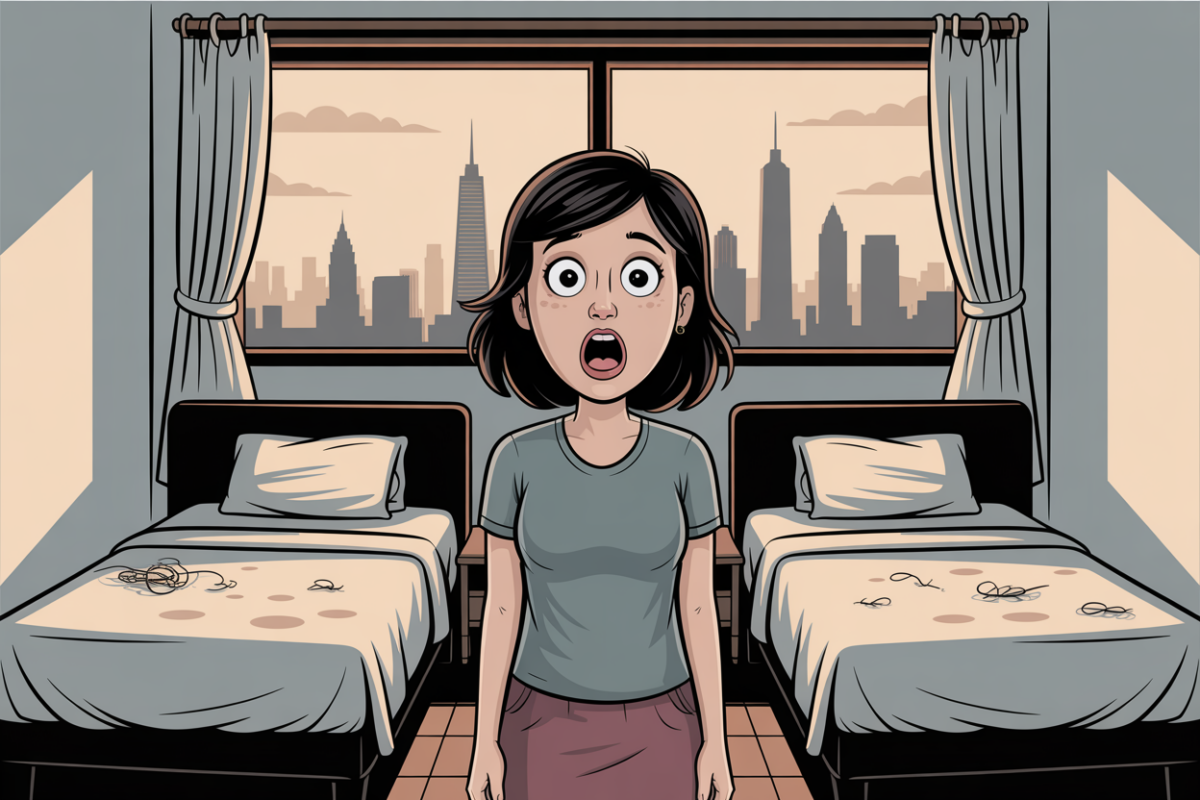
- Rebekah Singleton booked a room with two queen beds at a Brooklyn hotel through Booking.com. When she checked in, the beds measured out to full-size, not queen, and the room was filthy, with stained sheets, hair, and alarming red marks. A second room was worse.
- She left that night and booked elsewhere, then went to work on a refund of the $922 charge. The hotel denied her photo evidence, Booking.com offered a small goodwill credit, and even her credit card chargeback was reversed after the merchant pushed back, leaving her out nearly a thousand dollars for a room she never used.
- Her case raises a pointed question about who is responsible when a listing does not match reality: the property that advertised it, the platform that sold it, or the card issuer that first credited the charge and then took it back. When advertised and delivered do not match, what does a booking platform actually owe you?
Rebekah Singleton reserves a two-queen room in a Brooklyn, N.Y., hotel through Booking.com, only to discover dirty sheets, suspicious stains, and bait-and-switch bedding. Now, she’s battling the hotel and the booking platform with undeniable photo evidence to recover the full $922 charge she believes she is owed.
Question
I booked a room with two queen beds through Booking.com at a hotel in Brooklyn, N.Y. I needed the queen beds, and the room was clearly advertised as such.
However, when I checked in, the beds were obviously smaller—I later measured them to be approximately 50 inches wide, which is a full-size, not a queen. To make matters worse, the room was disgusting. The sheets had grease stains, hair, and what looked like suspicious red stains.
I asked for a new room, but the second one was worse, featuring a clear splatter of red stains across the floor.
I didn’t feel safe or comfortable and left that night, finding another hotel. I immediately contacted the hotel and Booking.com. The hotel denied my request for a full refund. Booking.com gave me the runaround for weeks and offered a mere $106 goodwill credit. I disputed the charge on my credit card. Capital One initially credited the $922 charge but then rebilled it after the merchant responded to the chargeback. I’ve sent all my photo and video proof to all three parties, and yet I’m still out almost a thousand dollars for a service I never used. What can I do to get my full refund? — Rebekah Singleton, Alexandria, Va.
Another booking.com case and a hard underline under “book direct, not third party.” No information about the hotel was given, was it an independent, or property of a “brand” hotel. Had the hotel been a branded hotel, and booked directly, her chances for resolution would have been better. Third party will almost always back away and say to contact hotel directly. Glad she was refunded and I hope she leaves an honest review of this skanky hotel.
Read more insightful reader feedback. See all comments.
Answer
This is an infuriating bait-and-switch case compounded by a gross disregard for public health and safety. The hotel falsely advertised accommodations with two queen beds and then gave you a room with smaller beds and alarming, unsanitary conditions, including suspicious red splatters. Ugh.
Despite your exhaustive paper trail documenting multiple attempts to resolve the issue with the hotel and Booking.com—including several long phone calls—both companies refused a full refund. The hotel simply denied your photographic evidence, and Booking.com attempted to settle the matter with a meager credit, claiming your valid health and safety concerns were merely a matter of opinion.
With the hotel refusing to budge and Booking.com failing its duty to ensure accurate listings and customer satisfaction, your most direct path was to resubmit a comprehensive dispute to Capital One, focusing on the clear contract violation of the room and bed size. This documented pattern of deceit and poor customer service should have ultimately won your chargeback. Incredibly, it didn’t. Your credit card company sided with the hotel, claiming you had “used” the services. I think it’s time for you to switch to a different credit card.
Could you have avoided this? Maybe. Reviewing the hotel’s ratings might have kept you away. It currently has 2 ½ stars out of 5, and the first review warns, “You are going to regret booking this hotel.” (I asked you about this, and you said at the time you booked the reviews were “a mixed bag but nothing completely egregious.”)
In a situation like this, you have options. You can escalate your complaint to Booking.com—I publish the names, numbers and email addresses of key Booking.com executives on my consumer advocacy site, Elliott.org. Or you could ask a consumer advocate for help.
You chose door number two, and I reached out to Booking.com on your behalf to find out if it really planned to force you to pay $922 for these shoddy accommodations. The answer, thankfully, was no.
“After a full review of the case, our customer service team has engaged directly with both the guest and the accommodation to resolve the situation,” a representative told me. “Given the concerns raised around room conditions and the customer’s overall experience, we’ve issued a full refund.”
I asked Booking.com if the hotel would be removed from the platform, and it said it would work directly with the property to make improvements. I guess everyone deserves a second chance, maybe.
A misrepresented room, a filthy space, and a chargeback that got reversed. This case raises hard questions about who stands behind an online hotel booking.
Your voice matters
What to know when a hotel room is not as advertised
A room that does not match its listing, or one that is simply filthy, leaves travelers scrambling for a refund. Here is what consumers ask most.
Document it immediately. Take time-stamped photos and video of the problems before you leave, whether that is bed size, stains, or unsanitary conditions. Then report it to the front desk and, if you booked through a platform, to that platform right away and ask for a new room or a refund. Both can share responsibility. The property is responsible for the condition and accuracy of the room, while the platform that sold it has a role in ensuring listings are accurate and that customers are treated fairly. In practice, travelers often have to press both, which is why documentation matters. You can request one, and a strong case rests on evidence. If the room was misadvertised or unsanitary and you left promptly, your photos, measurements, and a record of your complaints support a refund request. There is no guarantee, but a clear contract violation strengthens your position. A card issuer can rebill a disputed charge after the merchant responds to the chargeback, especially if the merchant argues you “used” the service. This is why it helps to frame a dispute around a concrete contract violation, such as the wrong bed size or a misrepresented room, rather than only on cleanliness, which a merchant may call a matter of opinion. Base it on facts that are hard to dispute. Provide the listing versus what you received, measurements, photos, and your written complaint history. Emphasize the clear mismatch between what was advertised and what was delivered, which is more persuasive to a card issuer than a subjective cleanliness complaint alone. Often, yes. Checking a property’s rating and recent reviews before booking can flag a place with a pattern of problems. A low overall score or pointed warnings in the first reviews are worth taking seriously, though reviews are not a guarantee either way. You do not have to accept a token credit as final. Escalate beyond frontline agents to named executive contacts at the platform, keep your documentation organized, and be clear about the refund you are seeking. If it stalls, a consumer advocate may be able to help. See Elliott Advocacy’s travel help resources.What should I do first if my hotel room is dirty or misrepresented?
Is the hotel or the booking platform responsible for a bad room?
Can I get a refund if I check out early because the room is unacceptable?
Why did my credit card chargeback get reversed?
How do I make a chargeback more likely to succeed?
Do hotel reviews really help me avoid a bad room?
What if the platform only offers a small goodwill credit?

Have a question about this story? Tell us what happened — we read every comment.
Join the conversation