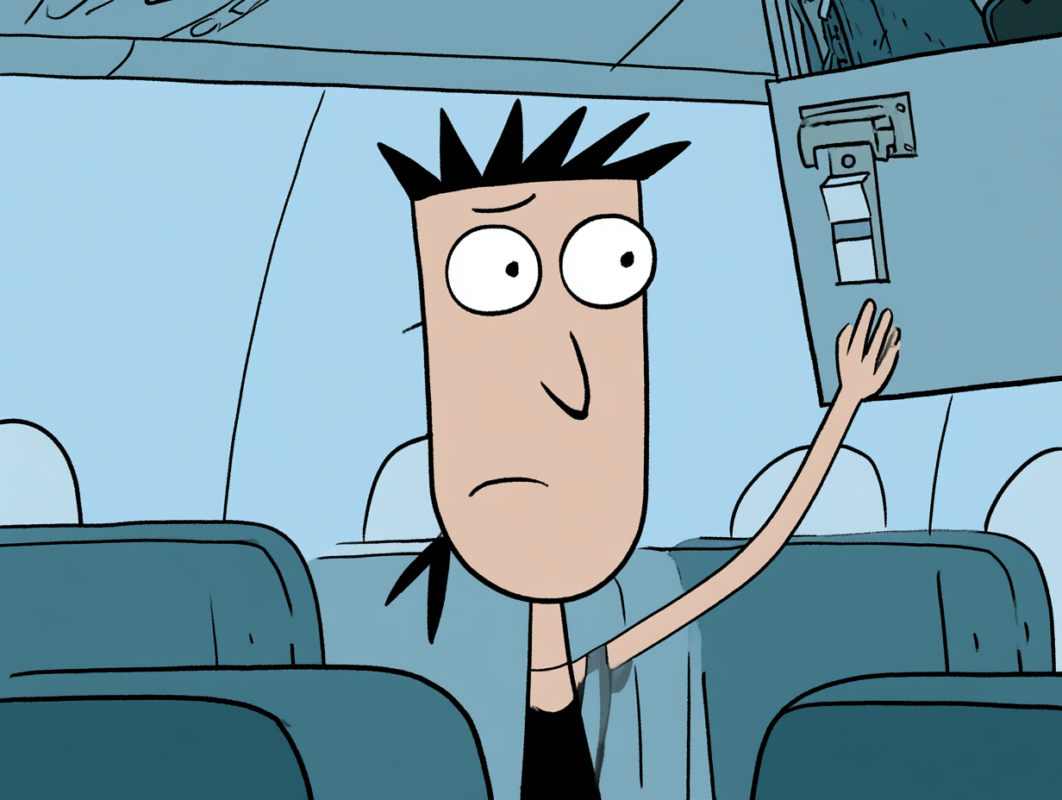
If you’ve ever wondered what they’ll think of next—at least when it comes to airline fees—here’s your answer: Jetstar announced this week that it will soon charge you to put a bag in the overhead bin.
Don’t confuse this with a fee for carry-on luggage. If you want to use the overhead bin for anything, you pay extra.
The reaction has been swift and merciless. Australian senator Bridget McKenzie called it “a cash grab.” On social media, indignant observers were asking whether pay toilets were coming soon. (Please don’t give them any ideas.)
Jetstar is the budget arm of Qantas, and it already charges for checked bags, seat selection, meals and entertainment. The bin was one of the last things in the cabin that didn’t have a price on it.
What will change on your next Jetstar flight
Starting next February, every fare will only include one under-seat bag of 40 by 30 by 20 centimeters—roughly a small backpack.
Anything larger has to go overhead, and going overhead requires an add-on called Priority Carry-on.
Overhead bin fees will run 25 to 52 Australian dollars one way—about $18 to $37—depending on the route. Sydney to Melbourne starts around 33 Australian dollars, for example.
There’s a silver lining: The 7-kilogram carry-on weight limit disappears, and staff stop weighing bags in the boarding queue. A 10-kilogram cap per item stays, for safety.
But that’s not all. Jetstar says Priority Carry-on is limited and can be booked only as long as overhead bin space remains available. So if Priority Carry-on sells out, you’ll be checking that bag at the gate, even if it contains valuables or prescription medications—and paying for the privilege.
This isn’t the carry-on fee you already know
Plenty of airlines already charge for a carry-on.
Frontier does, from about $29 at booking to $115 at the gate. Ryanair, Wizz Air and easyJet built their fare tiers around it. United won’t let you use the bin at all on a domestic Basic Economy ticket and charges $65 at the gate if you show up with a roller.
AirAsia caught me in Malaysia once. It measured my bag at the counter and charged me $30 on the spot.
Every one of those is a charge attached to a bag. Your suitcase is too big or too heavy, so you pay a penalty. United comes closest to what Jetstar is doing, because it locks you out of the bin entirely on basic economy tickets. But even United isn’t selling the bin itself.
The overhead bin has become inventory. What’s next, a credit card reader on the latch? (I’m sorry, I shouldn’t have said that. I just gave them another idea.)
Not sure what laws apply in this case, but I am a person who uses a mobility aid, in my case, a cane. Here is what I have been told on flights by crew in the last two years. “I will hang it with the jackets in first class”, “I won’t hang it with the jackets in first class”, “You have to put it under the seat in front of you”, “you can’t put it under the seat in front of you”, “you have to put it in overhead bin and no I can’t help you get it down” (the latter while I was still partially immobilized from surgery and could not stretch), and “you can’t put that in the overhead bin”.
I am willing to be flexible as some of this (not all of it) was down to different aircraft (same airline), but what I am not willing to do is pay for something I need to get around safely.
What Jetstar says
CEO Stephanie Tully says the new model will improve on-time departures and keep fares low, and that customers “pay only for what they need.” The airline says the change came out of feedback from passengers and its own staff, who named gate weighing and the fight for bin space as the worst parts of the airport experience.
In other words, you asked for this.
Critics say the move won’t land well because Australians have spent years with full-service expectations. Also, Jetstar’s starting fares already sit well above what Ryanair or Wizz Air charge for flights of similar length in Europe, because Australia lacks that level of competition.
Yes, but will it fix the overpacking problem?
Over the long term, probably not. It just displaces the problem of people carrying too much stuff on the plane. Charge for the overhead and passengers will just cram the free under-seat bag until it’s popping out the other side. Then a flight attendant will ask them to pay to check the offending bag.
There are also some inconsistencies. Jetstar’s own policy page says you may be asked to move your under-seat bag into the overhead bin at times. So the space isn’t quite yours, even after you buy it.
The real test is the fare. Unbundling is defensible when the base price also comes down. Australia’s transport minister made the same point through a spokesperson this week, saying it’s on Jetstar to demonstrate that the change keeps fares affordable. Watch what happens to prices in February.
If you said yes:
- What’s your ceiling? $18? $50?
- Would you pay it on a short hop, or only on a long flight?
If you said no:
- Would you switch airlines over it, or grumble and pay anyway?
- Can you fit a trip into a bag that goes under the seat?
My take
I fly on Jetstar a few times a year, most recently from Queenstown, New Zealand, to Melbourne in February. (They lost my luggage.) Whenever I mention to an Australian that I’ve flown on Jetstar, I get an eye roll and something close to an apology. Now I understand why. When it comes to ancillary fee innovation, the sky’s the limit for Jetstar.
Consider what the airline wants credit for here. It’s removing a weight limit it imposed in the first place, and charging you for a shelf that’s been bolted into the airplane since airplanes had shelves. The “generosity” is entirely in the framing.
The bin was never free, of course. It was always included in the price of your ticket. The question is whether the ticket gets cheaper now that the bin doesn’t come with it, and there’s nothing in this announcement to suggest it will. That makes this a fare increase in disguise.
Every revenue manager in the industry is watching Australia right now to see whether the anger outlasts the news cycle. It rarely does.
Your turn
Would you pay to use the overhead bin, or is this where you deplane? Our comments are open.

Have a question about this story? Tell us what happened — we read every comment.
Join the conversation