If you’ve checked airfares for the holidays, you probably already know this: It’s expensive. Really expensive.
Domestic round-trip fares for Thanksgiving average $402, up 31% from last year. Christmas fares average $452, a 23% jump. Both are the highest in a decade.
Fly home on the Sunday after Thanksgiving and you could pay more than $600 roundtrip. Yikes.
This isn’t the usual holiday markup. Fares were climbing long before anyone started shopping for a seat home. The government’s Consumer Price Index shows airline fares up 23% in August compared with a year earlier. In May, the average ticket sold through travel agencies cost 18% more than a year before, even though the number of trips didn’t budge, according to Airlines Reporting Corp.
So are you being fleeced? Or have airline costs really gone up that much?
What’s driving fares higher?
Many factors are to blame, according to experts.
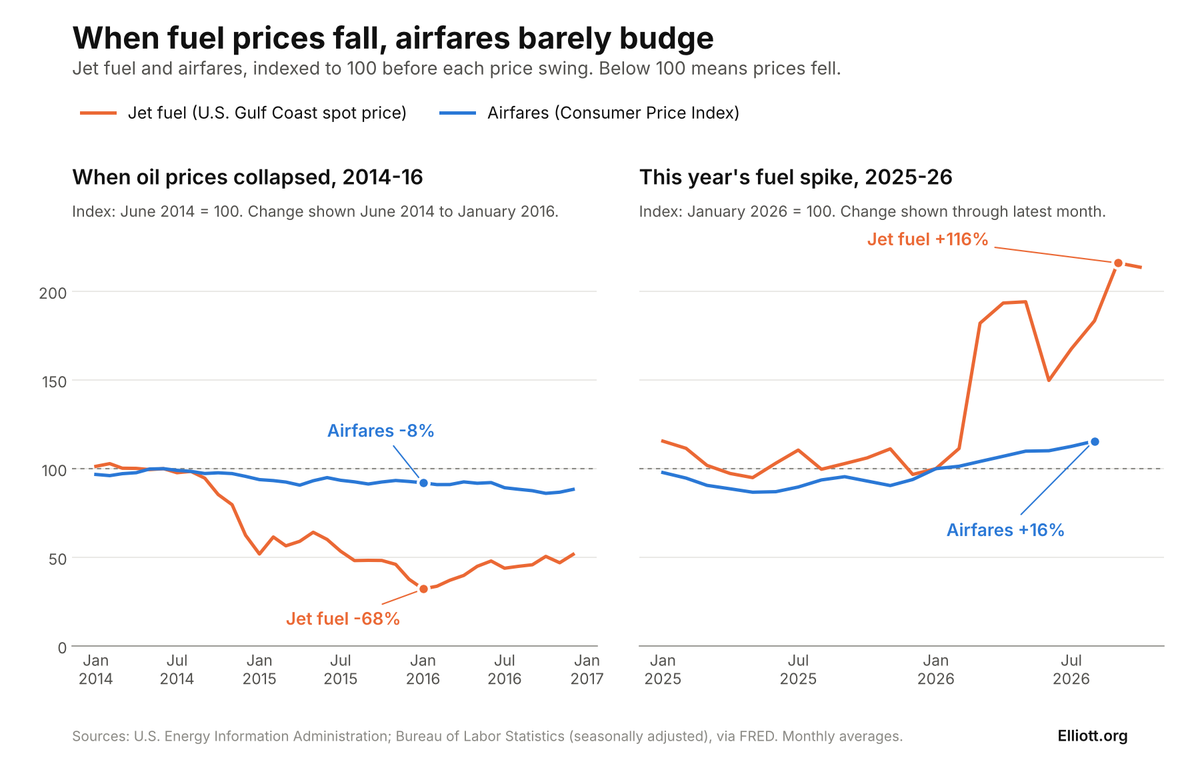
Fuel costs are up. The war in the Middle East shut down nearly all Gulf airspace when it began, and oil prices soared. The International Air Transport Association expects jet fuel to average $152 a barrel this year, almost 70% more than in 2025. Fuel accounts for nearly a third of an airline’s operating costs. U.S. carriers have largely stopped hedging fuel, so IATA expects them to pass those costs on to passengers quickly.
Then there’s demand. Consumers are gloomy. The University of Michigan’s sentiment index fell to 48.1 in September, near a record lows. They’re flying anyway. “We haven’t seen elasticity,” Delta CFO Erik Snell told analysts in July. Allow me to translate: Delta raised prices and people kept buying. The airline says more than 60% of its fourth quarter is already booked.
There are also fewer seats to go around. Delta’s third-quarter revenue rose 16% while its capacity stayed essentially flat. Spirit Airlines shut down in May, and no low-cost carrier has filled the gap. Delta CEO Ed Bastian says the industry may need to grow even less in 2027. “In a high-cost environment you cannot grow your way out of it,” he said earlier this month. In other words, expect fewer flights and fuller planes.
Is an algorithm setting your fare?
Delta uses an AI pricing tool built by an Israeli company called Fetcherr. In July 2025, the airline said the tool covered about 3% of its domestic fares, with a goal of 20% by the end of that year.
Congress wants to know more. On Aug. 11, Rep. Frank Pallone (D-N.J.), sent letters to eight airlines asking whether they use personal data to set prices. He cited a study estimating that one airline raised its revenue by up to 6% through AI pricing based on consumer data. Delta President Peter Carter replied that “the fares we file do not take any customer’s personal data into account.” He called the tool a “decision-support tool” and said human analysts still set fares.
Regulators aren’t taking anyone’s word for it. The Federal Trade Commission voted 2-0 on Aug. 19 to propose a policy statement that would require companies to clearly disclose when a price is personalized and what data are behind it. New York and New Jersey have already passed laws aimed at regulating personalized pricing.
Wait, aren’t airlines just covering their costs?
That’s the industry’s argument. Delta expects to spend about $6 billion more on fuel this year, and it cut its earnings forecast. IATA projects that North American airlines’ profit margins will slip to 2.5% this year from 3.5% in 2025.
Now listen to how Bastian described the year. On the Oct. 9 earnings call, he praised “the ability of the industry to get much greater value for the product that we offer” and said “it took a fuel spike in a short order to move people in that direction.”
Delta raised fares about 20% this year, and Bastian pointed to “the limited amount of resistance that we see.” The airline still expects about $4.5 billion in pretax profit, roughly level with last year.
Thanks for paying, everyone.
If you voted yes:
- Avoid the Sunday after Thanksgiving if you can. Return fares that day top $600, according to Hopper.
- Set a fare alert now and track your route. Prices change daily, and waiting for a holiday sale is a gamble this year.
If you voted no:
- Tell us why the fares look fair to you. Are you using points, flying off-peak or simply willing to pay?
- You’re the passenger Bastian is counting on. (He’ll thank you on the next earnings call.)
My take
I’m constantly on the road, and I’ve been monitoring one-way fares between Spokane, Wash., and Auckland, New Zealand, for the last few weeks. The prices have been volatile, fluctuating between $500 and $700. It feels like the revenue managers at American, Delta and Air New Zealand keep trying to raise ticket prices, only to pull back when people stop buying.
I’ve seen this before. In May 2008, with oil at $130 a barrel, American Airlines announced a $15 fee for the first checked bag. CEO Gerard Arpey blamed “the current reality of slow economic growth and high oil prices.” Oil prices collapsed later that year, but the bag fee never went away.
In 2015, jet fuel fell from more than $3 a gallon to under $1.70. Airlines kept the fuel surcharges anyway, including $458 per passenger on flights between New York and London. That summer, the Justice Department sent letters to the four largest U.S. airlines as part of an investigation into whether they had coordinated to limit seats.
Economists who study this say fares do follow fuel prices down over time. The average domestic fare fell 8% in the fourth quarter of 2015. But one study found fares dropped only about 12% after crude oil fell 57%, and oil prices couldn’t explain the gap. “Over time” is cold comfort when you’re buying four tickets home for Christmas.
Airfares are too high, but the real test is what happens when fuel costs come down. Bastian has already said passengers aren’t pushing back, and analysts say holding fares at their current levels is the key to higher airline margins in 2027. (Of course they’d say that.)
If fuel falls and fares don’t, we’ll know the industry used a war to reset what it charges, and every carrier that follows Delta’s lead will be counting on you not to notice.
Your turn
What do you think about the high holiday fares? Our comments are open.

Have a question about this story? Tell us what happened — we read every comment.
Join the conversation