Don’t look now, but the extras travelers pay are on the rise.
Just this month, the Department of Homeland Security’s annual inflation adjustment raised the ESTA fee that visitors from visa-waiver countries pay to enter the U.S. from $40.27 to $40.62, an increase of about 1%.
It’s happening everywhere. Edinburgh started charging a new visitor levy in July. Japan tripled its departure tax over the summer. Barcelona raised its tourist tax in April, with more increases already scheduled across Catalonia next spring.
Elected officials pass tourist taxes, write them into law and usually earmark them for a purpose, such as raising money for infrastructure or deterring excess visitors (and sometimes both). But does that make them fair?
What you’ll pay
Here’s a rundown of the most significant visitor taxes and entry fees on the books now or coming soon.
Europe
- Edinburgh: A 5% levy on the cost of your room for stays starting July 24.
- Barcelona: Under Catalonia’s Law 2/2026, which took effect April 1, the regional tax in Barcelona ranges from 1 euro (about $1.10) per person per night in a youth hostel to 7 euros in a five-star hotel. The city can add up to 8 euros on top of that. Cruise passengers pay 4 euros if their ship stays more than 12 hours and 6 euros if it stays 12 hours or less. The rest of Catalonia gets a second increase on April 1, 2027. Outside Barcelona, the five-star rate goes from 4.50 euros to 6 euros per person per night, and the four-star rate from 1.80 euros to 2.40 euros.
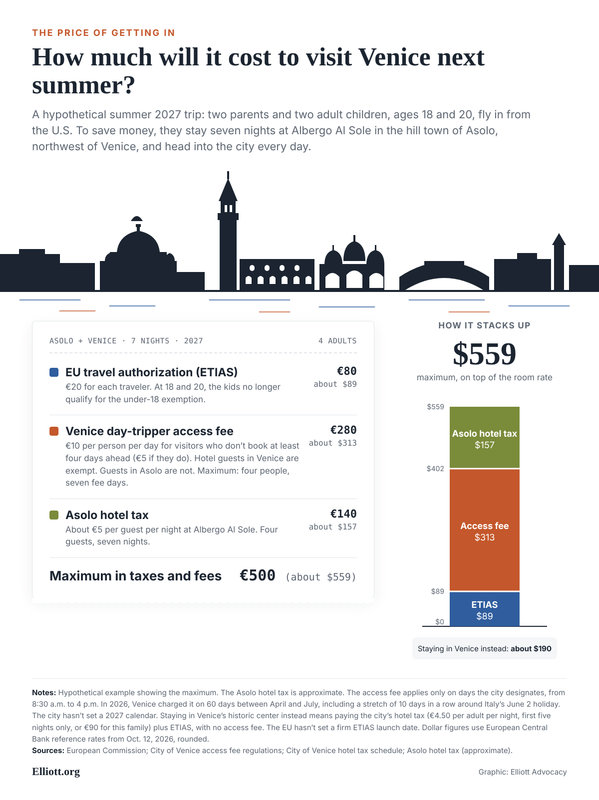
- Venice: Day-trippers paid an access fee of 5 euros if they booked at least four days ahead and 10 euros if they didn’t. The fee applied on peak days during this year’s trial, which ended July 27. The city hasn’t decided whether the fee will return next year.
- United Kingdom: The Electronic Travel Authorisation now costs 20 British pounds (about $26). That’s up 25% from 16 British pounds before the Home Office raised it April 8.
- European Union: The new ETIAS travel authorization will cost 20 euros, almost triple the 7 euros originally planned. The European Commission had targeted a launch in the last quarter of 2026. Recent reports suggest the launch will happen in 2027.
Asia-Pacific
- Japan: The international tourist tax rose from 1,000 yen (about $6) to 3,000 yen (about $19) this summer, more than a three-fold increase.
- Kyoto: The accommodation tax is now tiered by room price, according to the city. It’s 200 yen (about $1.25) per person per night for rooms under 6,000 yen (about $38) and climbs to 10,000 yen (about $63) per person per night for rooms that cost 100,000 yen (about $630) or more.
- New Zealand: The International Visitor Conservation and Tourism Levy is NZ$100 (about $56) per person, once every two years. Australian citizens and permanent residents are exempt, along with people from most Pacific islands.
We’ve returned the favor, so to speak …
United States
- Hawaii: The transient accommodations tax rose from 10.25% to 11% on January 1 and stays at that rate through 2030, according to the state Department of Taxation. The law also tried to apply the tax to cruise fares. A federal appeals court blocked that part.
- National parks: Non-U.S. residents age 16 and older now pay a $100 nonresident fee at 11 of the busiest parks. That list includes Yellowstone, Yosemite, Grand Canyon and Zion.
Why destinations say it’s fair
The strongest argument for a tourist tax is that visitors use the streets, trains and trails, so they should help pay for them. The places that make that case disclose where the money goes.
For example, Edinburgh’s council expects its levy to bring in up to 50 million British pounds a year once the program is established. After administrative costs, 5 million British pounds a year goes to housing and to offset the burden of tourism on the city. The rest goes mostly to city operations and infrastructure (55%) and to culture, heritage and events (35%). Hotels keep 2% for collecting it. Council Leader Jane Meagher called the levy a “once in a lifetime opportunity to invest tens of millions of pounds” in the city.
Kyoto is also specific. Its tax pays for platform screen doors in subway stations, preservation of cultural properties and efforts to cut crowding and litter. New Zealand says its levy funds conservation and visitor infrastructure. Japan says its departure tax pays for measures against overtourism, including spreading visitors out to less-crowded regions.
If you’ve ever been stuck in a crowd on a Kyoto bus, the idea of paying a few hundred yen toward fixing that problem doesn’t sound unreasonable. Or does it?
So where’s the line?
Some of these taxes are harder to defend.
The national park fee charges foreign visitors $100 more than Americans to stand at the same overlook. New Zealand also gives some nationalities a pass, but its exemption covers neighbors with deep travel ties to the country. Pricing by passport is harder to defend.
Entry authorizations raise a different question. The U.K. and the EU both charge for the Electronic Travel Authorisation (ETA) and European Travel Information and Authorisation System (ETIAS), and the U.S. charges for Electronic System for Travel Authorization (ESTA). None of these fees is tied to anything a visitor uses on the ground. They’re the price of being allowed to board the plane. The EU nearly tripled its fee before the system even launched.
Stacking is another problem. A family of four flying to London pays 80 British pounds in ETA fees before anyone leaves home. That same family pays 12,000 yen (about $76) just to leave Japan, plus Kyoto’s nightly tax on top of whatever their hotel adds. None of these charges is large on its own. Together, they can really add up.
There’s also the question of who pays. Visitors can’t vote in Edinburgh, Barcelona or Honolulu, which makes them an easy target for any city council that needs revenue.
If you said yes …
- Do you feel better paying for the infrastructure that you use?
- Do you favor places that show you the receipts?
If you said no …
- Do you look for destinations that have lower taxes?
- Would you refuse to visit a place that has high taxes or that doesn’t tell you what the money is used for?
My take
Since I travel more than 330 days a year, I pay these taxes about as often as anyone. I get hit with New Zealand’s fees almost every time I go back to Auckland.
I don’t object to paying for the places I visit. But I have a problem with paying without knowing where the money goes. The taxes that bother me most are the fees that keep climbing without any visible improvement on the ground. The growing habit of charging visitors more simply because they’re visitors bothers me, too.
Before you book next summer’s trip, look up the visitor taxes at your destination. The tax rarely appears in the advertised room rate, but you’ll find it on your final bill.
Your turn
Have you paid a tourist tax that felt like a fair deal, or one that felt like a shakedown? Tell us where you were and what you paid. Our comments are open.you paid. Our comments are open.

Have a question about this story? Tell us what happened — we read every comment.
Join the conversation