If there’s a perfect car rental customer, it is probably Tasha Huebner. She’s responsible, careful, and she returns her vehicles in what she describes as “pristine” condition.
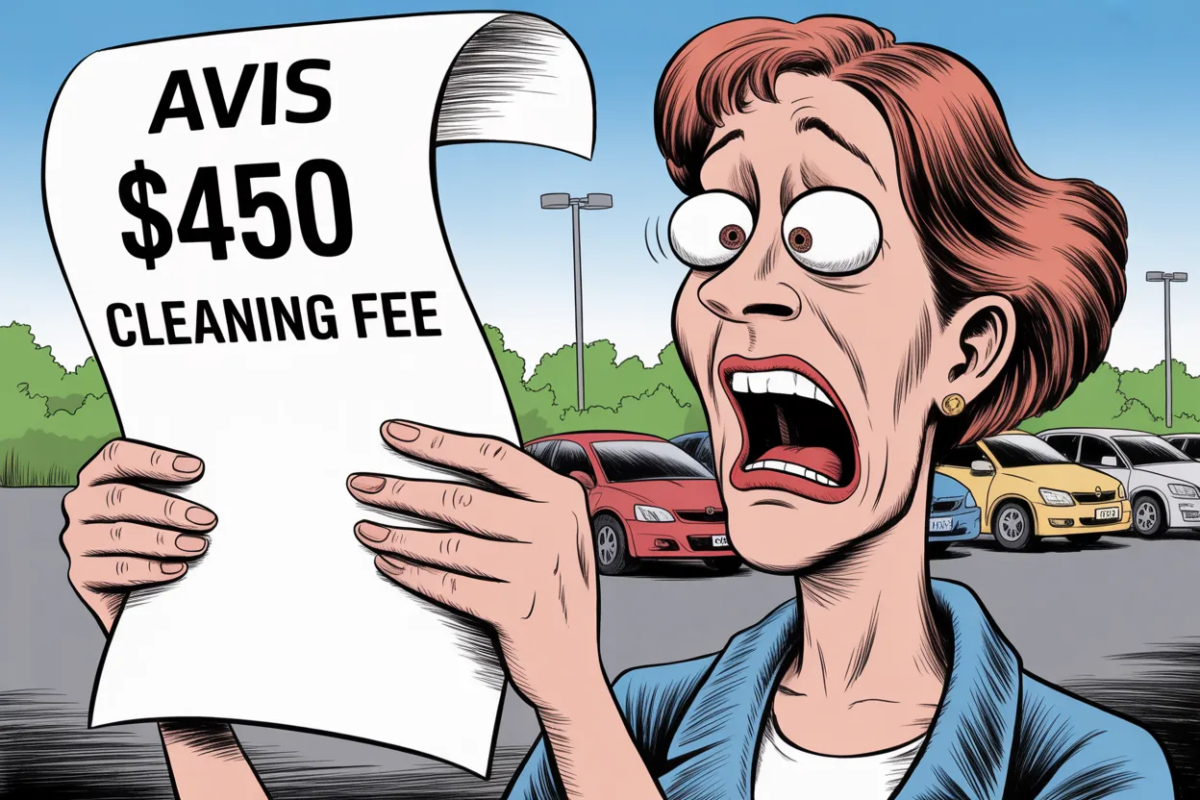
So why is Avis hitting her up for an extra $450 for trashing her car?
The charge is for a “special” deep cleaning—for smoking.
Just one problem: Huebner doesn’t smoke. Neither does her travel companion, Cori. In fact, the accusation was physically repulsive to them.
“Only my friend Cori and I were in the car and neither of us smokes,” Huebner told me. “We’re both cancer survivors and initially met some 10-plus years ago through an organization for young women with breast cancer.”
The Elliott Confidential Podcast
Camel City or Bust!
A deep dive into the troubling paper trail behind this case. We’ll share the ACTUAL emails, and more.
Accusing two breast cancer survivors of chain-smoking inside a Chevy Malibu seems wrong. And charging them an extra $450 is way out of line.
But Avis wasn’t done. It also slapped her with a fuel service charge of over $30 for four gallons of gas. This was strange, considering Huebner had filled the tank at a Shell station less than a mile from the airport.
Huebner was caught in a bureaucratic pincer movement: accused of a vice she doesn’t practice and billed for gas she didn’t use.
This case raises several critical questions for anyone renting a car:
- Is the “smoking scam” becoming the new preferred revenue stream for the travel industry?
- What constitutes valid proof of smoking when a company wants to charge you $450?
- How do you fight a cleaning fee when the company holds all the cards—and your credit card deposit?
Hertz tried a variation of this at Frankfurt-am-Main airport. Agents claimed I left dog fur in the car and wanted to charge a cleaning fee. Told them I have never owned a dog, do not like dogs, and certainly wouldn’t bring one to Germany to drive around with me.
“I honestly asked them if they were insane”
Huebner rented a car from Avis to attend a memorial service and visit her brother in Illinois. It was a somber trip, not a joyride. She returned the car without incident. There were no warning lights, no damage, and certainly no clouds of smoke billowing out the windows.
But a few days later, the receipt landed in her inbox.
The $450 cleaning fee is the nuclear option of car rental charges. It is the maximum amount most agencies will charge for a deep cleaning. To justify this, you’d expect the car to look like the inside of a frat house after Homecoming weekend.
Huebner was stunned.
“I honestly asked them if they were insane,” she says.
She immediately contested the charge. Avis responded not with a retraction, but with a PDF containing grainy images of the car interior.
“It looked like water spots or something,” she recalls.
There were no pictures of cigarette butts or burn marks on the upholstery. Just grainy ambiguity and a demand for payment.
After some back-and-forth, Avis made a benevolent offer to reduce the fee to $250.
This is a classic negotiation tactic used by claims departments. They know the $450 charge is bogus, so they offer to cut it in half. The weary traveler, terrified of a collection agency or a permanent ban, often pays the $250 just to make the problem go away. It is the cost of doing business.
But Huebner was fuming—and she refused.
“I still said that was insane, because I had returned the car in pristine condition,” she says.
She was at a stalemate. Avis had her credit card, which it could charge. She had the truth. (In the world of travel disputes, the money usually wins.)
And that’s when she contacted our team.
Is the smoking scam the new junk fee?
Let’s answer the first question: Is this happening more often?
Yes, unfortunately it is.
In recent years, I have seen a dramatic uptick in complaints about erroneous cleaning fees. It is not just smoking. I recently advocated for a consumer who was charged $450 by Budget for dog hair, despite not owning a dog. I’ve seen charges for sand in cars that never went near a beach and “excessive dirt” on floor mats that looked brand new. (Of course, if you do trash a rental car, you should pay to have it cleaned. That goes without saying.)
But the smoking charge is the most insidious because it is the hardest to disprove. You can photograph a clean seat. You can video a lack of dents. But how do you photograph a smell?
You can’t. And the rental companies know it.
The rise of these smoking fees correlates with the tightening of margins in the travel industry. When rental rates drop or fleet costs go up, ancillary fees become the lifeblood of the profit and loss statement. A $450 cleaning fee is pure profit. It requires no parts, no skilled labor, and often, no actual cleaning.
For Huebner, the accusation was particularly stinging. As a cancer survivor, she’s hyper-aware of health risks. The idea that she would light up in a rental car is ludicrous. But to an algorithm or a remote claims adjuster viewing a grainy PDF, she represented just another revenue source.
The gas charge she received adds weight to the theory that this was a systemic failure—or a systemic strategy—rather than an isolated mistake.
Charging for gas when the tank is full is the “did you check the minibar?” of car rentals. It’s a lazy attempt to pad the bill, hoping the customer won’t notice or won’t have the energy to fight.
What constitutes valid proof of smoke damage?
This brings us to our second question: What proof does a company need to confiscate $450 from your bank account?
Legally? Not much. Practically? Even less.
When you sign a rental agreement, you are essentially handing the company a blank check for damages. The terms and conditions are written by lawyers who anticipate these disputes. They use vague language like “excessive soilage” or “odors,” giving the company broad discretion.
In Huebner’s case, the “proof” was laughable. Grainy photos of water spots do not prove smoking. They prove it rained, or perhaps someone spilled a bottle of Dasani on a seat.
To sustain a smoking charge, a company should provide:
- Physical evidence: Cigarette butts, ash in the console, or burn marks.
- Time-stamped inspection logs: A report showing the smell was detected immediately upon return, not days later after the car has been moved by porters who might be enjoying a smoke break.
- Cleaning receipts: An invoice from a third-party detailer proving the work was actually done.
Avis provided none of this. It sent a PDF that proved nothing other than the fact that their camera has a low resolution.
The timing is also suspect. In many cases I handle, the smoking charge appears days or even weeks after the return. I’ve seen cases where Budget waited almost a month to charge for dirty floor mats.
If a car smells like heavy smoking, as Avis claimed, the return agent should smell it the moment the door opens. It should be flagged instantly.
When the charge comes later, it suggests the smell might have come from an employee moving the car, a subsequent renter, or—more likely—it doesn’t exist at all.
How to fight back against a smoking fee and win
So, how do you fight a smoking fee? Huebner’s approach is a textbook example of what I call the Elliott Method.
- Don’t get angry on the phone. The frontline employees at the 800-number have no power. They’re reading from a script. They are the human equivalent of a “Do Not Enter” sign. Arguing with them is like trying to explain physics to your cat.
- Create a paper trail. Huebner emailed Avis’ customer service department. She kept records. She forced them to put their “evidence” (the grainy photos) in writing. This is crucial. When you force a company to document its lie, the lie often falls apart.
- Appeal to a higher power. Most consumers stop when the department says “no” or offers a token refund. Huebner didn’t. She refused the $250 compromise and escalated to a manager.
“I honestly wondered if they had the wrong car,” she said.
Huebner found the executive contacts for Avis on my consumer advocacy site. These are real people—vice presidents and CEOs—not chatbots.
She wrote a concise, calm email. She explained the absurdity of the charge. She mentioned her history as a cancer survivor (establishing credibility and emotional weight). She pointed out the factual error regarding the gas charge (establishing the company’s incompetence). She had the receipts to prove it.
And she did one more thing, which I always recommend: She cited a precedent. She included a link to an article she found about a similar $450 fee from another Avis-owned brand. This showed she was informed and that she knew this was a pattern.
She sent the email to the two executives listed on my site. And, “just for the hell of it,” she copied the CEO.
Avoiding a PR nightmare
The laws of corporate customer service say you can’t be a heavy smoker and a cancer survivor falsely accused of smoking without creating a massive PR headache.
“No lie, not 10 MINUTES later, I heard from the department I had been going back and forth with,” Huebner says.
Their attitude had changed. Avis removed the $450 charge and the gas fee. Then came another email apology. Then came a phone call.
“It was kind of nuts,” Huebner told me. “Talk about results!”
Why did this happen? Because she bypassed the algorithm and reached a human who could recognize the absurdity of the situation. A low-level claims adjuster looks at a screen and sees a revenue opportunity. An executive looks at an email from a cancer survivor with a flawless rental history and sees a brand liability.
It’s likely the gas charge—$30 for four gallons when the tank was full—was the smoking gun. It proved the return agents hadn’t done their job. If they were wrong about the gas, they were probably also wrong about the smoke.
“Victory was mine!” Huebner wrote to me. “And yours, because I know I would have gotten nowhere without your assistance.”
The takeaway
This victory belongs to Huebner, actually. She refused to accept a compromise for something she didn’t do.
If you rent a car, protect yourself. Take photos of the interior and exterior when you return it. Keep your gas receipts and take a photo of the gas gauge. And if you get hit with a bogus smoking fee, don’t pay it—fight it.
These fees are a tax on the passive. They rely on you being too busy or too intimidated to fight.
Avis tried to charge two cancer survivors for smoking. It picked the wrong customers. And thanks to Huebner’s persistence, the air is finally clear.

Have a question about this story? Tell us what happened — we read every comment.
Join the conversation