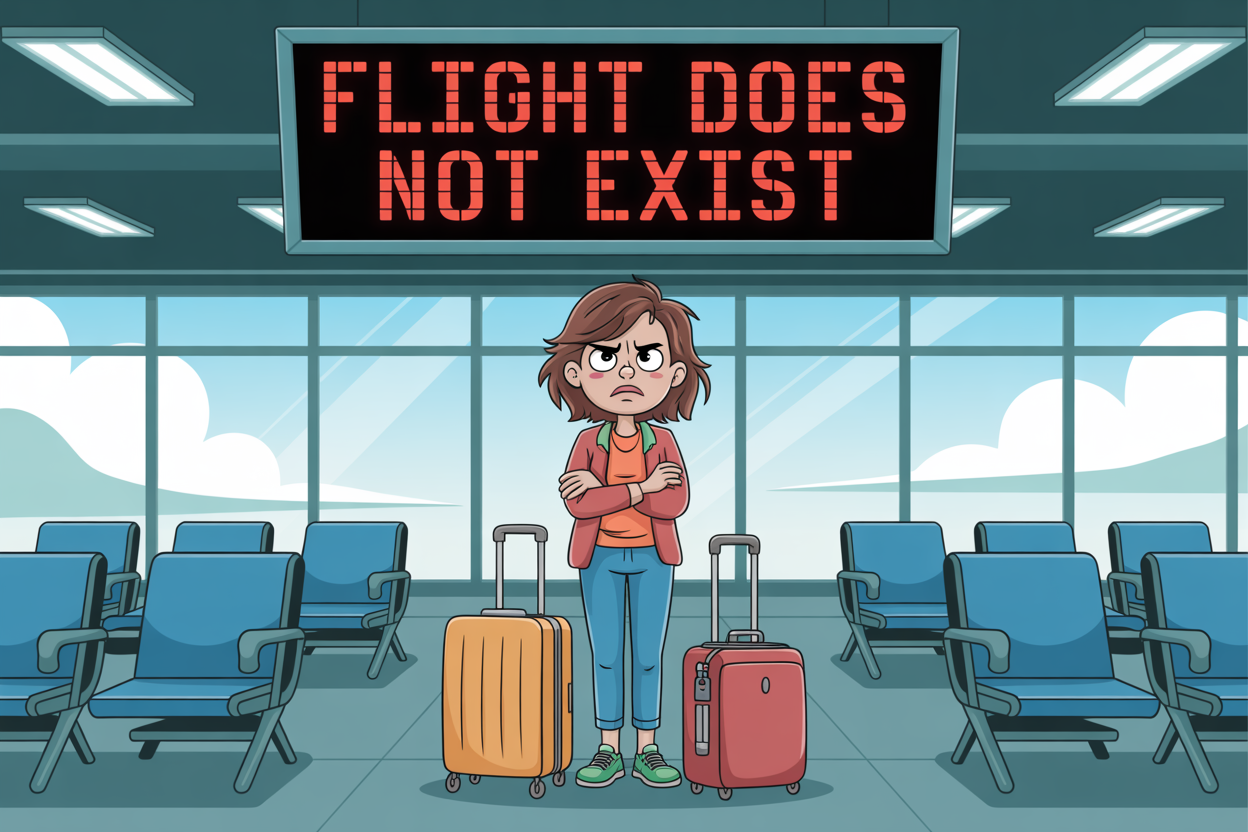
Cartoon of a frustrated traveler with arms crossed standing between two suitcases in an empty airport gate area, beneath a large red departures sign reading "FLIGHT DOES NOT EXIST."

Booking.com said my flight was confirmed, but the airline says it never existed

Lindley Kinerk’s last morning in Dresden seemed routine. She and her companions packed up, checked out, and headed to the airport for their 8:25 a.m. flight home to Boston. They had even gotten a friendly check-in reminder from Booking.com the night before. Then they reached the counter and learned something that would cost them nearly $6,000: their flight did not exist. Not that morning, not any morning. It had been off the airline’s schedule for months. Booking.com, it seems, had quietly rebooked them on an earlier flight and never said a word, and the airline insisted the whole thing was not its problem. With a third ticketing agency tangled into the booking and every company pointing at the others, Kinerk had to buy new tickets on the spot just to get home. What she did next, and what Booking.com eventually said about her money, is where this case turns.
Black and white cartoon of a small couple with suitcases standing on a dark horizon, watching a paper airplane folded from a banknote fly up and away into a vast cloudy sky.

Air travelers deserve stronger consumer protections—in Europe and the U.S.

Mila Schoun knew what his downgrade was worth, but his airline pretended it did not. Schoun and his wife had paid Swiss International Air Lines for premium economy on a flight from Prague to Miami, and then the airline changed aircraft and put them in regular economy for the 10-hour crossing. He asked for the difference back. Swiss refused. What Schoun had on his side, even if he had never heard of it, was EC 261, a 21-year-old European regulation that makes airlines pay when they cancel, bump, strand, or downgrade you, and that quietly protects millions of Americans on any flight leaving an EU airport. Europe just spent the spring fighting over whether to gut that law, with the airline lobby pushing to raise the delay threshold and erase most claims. Passengers appear to have dodged the worst of it. But there is a quieter problem that no one in Brussels lobbied for and no one fought against, one that has been draining the value out of this protection for two decades while everyone argued about something else.

Black and white cartoon of a frazzled airline passenger facing a smiling gate agent at a counter, who holds up a document labeled "OUR RULES," illustrating the gap between what travelers want and what the DOT's disclosure rule actually delivers.

Congress asked for passenger rights. It got a PDF

Airline passengers are tired of standing at the gate while agents hand out excuses. The Department of Transportation has a fix. Soon, airlines will hand out a piece of paper instead. The DOT just finalized a rule requiring airlines to publish a one-page summary of passengers’ rights. Congress ordered it eight years ago. The rule does not set any compensation amounts. It does not require meals, hotels, or rebooking when there is a delay. Each airline only has to briefly summarize its own existing policies, in whatever format it likes. The rule also skipped the public comment period, and in a detail that is hard to make up, the summaries are not even due yet, because carriers cannot submit anything until a separate government approval process is complete. When the regulated industry shrugs at a new regulation, that means something, and this rule drew no objection at all.