
in this case
- Debbie McNulty had listed her vacation home on Furnished Finder for three years without ever receiving a booking, and paid the annual fee anyway.
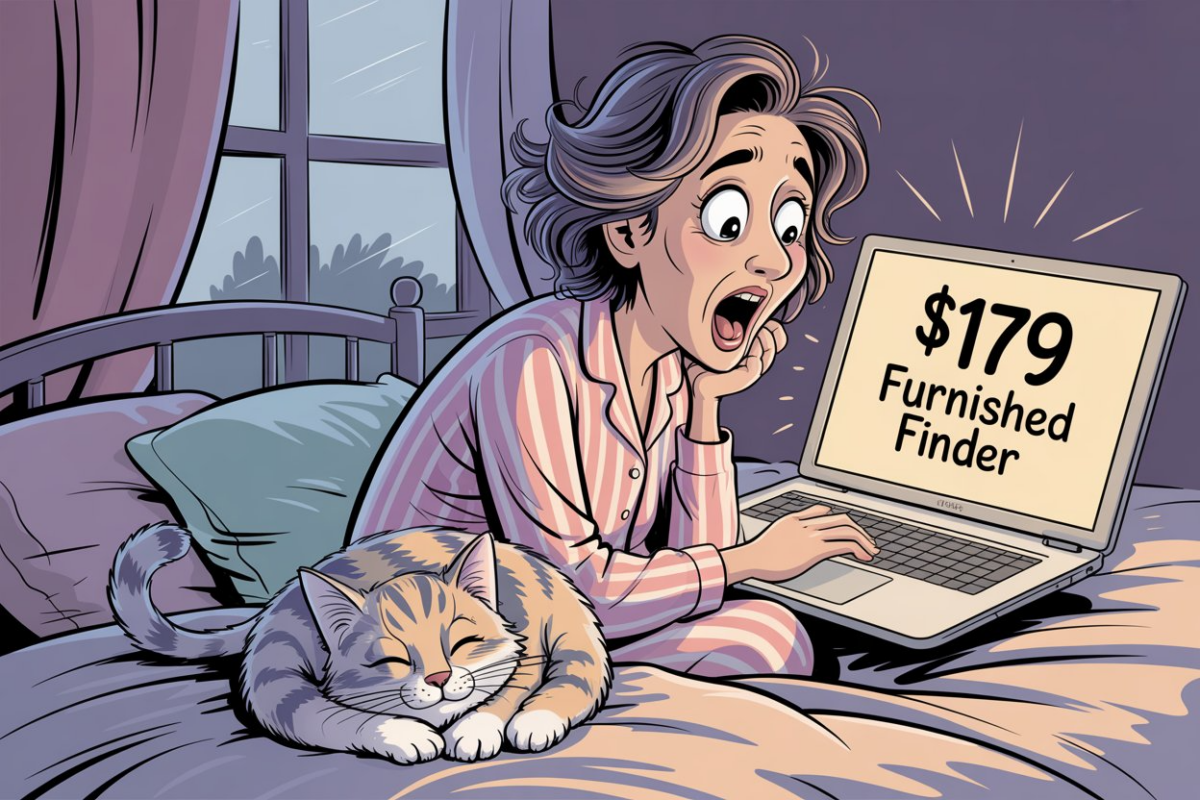
- Her membership was set to auto-renew. The company sent one reminder email the month before, and she missed it. She woke up to a $179 charge.
- She contacted the company the same day the charge went through, asked to cancel, and requested a refund. The answer was a form reply: fees are nonrefundable.
When Debbie McNulty discovers a surprise $179 charge on her credit card from Furnished Finder, she immediately asks for a refund. Why is the company trying to keep her money?
Question
I’ve listed my vacation home on Furnished Finder, an online platform for monthly furnished rentals, for the past three years. I never received a booking from Furnished Finder during that time, but I was fine paying the annual fee. Now that I’m renting short-term again, I no longer need to list on Furnished Finder.
My membership was set to auto-renew. Furnished Finder sent one reminder email last month, but I totally missed it. We all get so much email these days, and I was just back from a two-week trip, so I overlooked it. My bad.
When I woke up to a $179 charge from Furnished Finder last week, I immediately contacted Furnished Finder to cancel and requested a refund. A representative sent me a standard response that their policy is not to give refunds.
It’s in the contract, I get it. I should have notified them before the renewal date. Still, the fact that I contacted them on the very same day that they processed the renewal makes it seem petty to keep my money. I asked to escalate the request on the basis that granting me a refund was the right thing to do. Do you think it is worth asking again? — Debbie McNulty, Los Gatos, Calif.
I usually agree with you Chris, but not on this one. It’s not the company’s fault she missed the email. And even if she did miss it, she should have canceled the subscription when she knew her property was no longer suited for the long-term tenants Furnished Finder serves. Doesn’t anyone take responsibility for their own mistakes these days?
Read more insightful reader feedback. See all comments.
Answer
Yes, it’s definitely worth asking. Furnished Finder should have refunded your $179.
While the company is technically correct — you agreed to the terms and conditions, which state that all fees are nonrefundable — hiding behind the fine print in this situation is bad customer service.
You canceled on the same day the charge went through. You had a valid reason for leaving the platform, as your property is no longer suited for the long-term tenants Furnished Finder serves. Keeping your money for a full year of service you clearly stated you wouldn’t use seems unreasonable.
Companies love automatic renewals because they’re convenient. A business doesn’t have to pursue every customer, asking them to renew every year. Instead, they simply send a courtesy reminder, and you can cancel before the auto-renewal date.
But in your case, that single email got buried in your inbox. By the time you saw the charge, the company claimed it was too late.
I have a little personal experience with running a business that handles automatic subscription renewals. What you might not know is that about 80 percent of credit card disputes for an unwanted auto-renewal goes the customer’s way. So if you’d filed a credit card dispute, you’d probably have your money by now.
The takeaway here is to treat every subscription like a ticking clock. Don’t rely on the company to remind you that your bill is due. Set your own calendar alerts for a few days before a cancellation deadline. And if you aren’t 100 percent sure you’ll want to renew, it’s often safer to turn off the auto-renew option the moment you sign up.
You did exactly what I always recommend: You kept a thorough paper trail. You saved your chat transcripts with the virtual assistant and the live agents, as well as your email correspondence. This evidence showed that you acted in good faith and tried to resolve the issue immediately.
I contacted the company’s CEO, Jeff Hurst, on your behalf. He reviewed your case and replied, “We’ll get this refunded.”
You’ve received the full $179 back.
One missed email, one $179 charge, and a cancellation request the very same day. McNulty’s case is the kind almost everyone has come close to.
Your voice matters
Auto-renewals: your options when a charge catches you out
A subscription that renews itself is not always the last word. Here is what readers ask most. This is general information, not legal advice.
Contractually you may well have agreed to it, but a company can always choose to make an exception, and many do when a customer cancels immediately and clearly will not use the service. Enforcing the letter of the policy in that situation is a customer-service decision rather than a legal necessity, which is why a polite, well-documented appeal is worth making. Yes, though the landscape shifted recently. A federal click-to-cancel rule was vacated by a federal appeals court in July 2025 on procedural grounds and is not in force, and the Federal Trade Commission has since restored a much narrower older rule while moving to restart rulemaking. What remains federally is the Restore Online Shoppers’ Confidence Act, which requires clear disclosure of terms, informed consent before charging, and a simple way to stop recurring charges. Often yes, and that is where the real protection now sits. California has the strictest automatic renewal law in the country, amended in 2025 to add easier online cancellation, renewal reminder obligations, and a prohibition on cancellation dark patterns. New York, Colorado, Massachusetts and others have their own versions. Because the rules vary by state and by the type of subscription, check your own state’s requirements. Not always, and this is an important distinction. Automatic renewal laws are generally written to protect consumers. If you subscribe to a service in order to run a business or advertise a property, the subscription may be treated as a commercial arrangement, where those consumer protections can be weaker or absent. It is worth confirming which category your subscription falls into before you rely on a statute. It is a real option for a genuinely unwanted renewal, especially where you can show you canceled promptly. Bear in mind that once a dispute is open, the merchant often cannot issue a voluntary refund without risking paying twice, so it can stall a negotiated resolution. Many people have better luck asking the company first and keeping the dispute in reserve, while watching the filing deadline. Switch off auto-renew when you sign up if you are unsure about a second year, and set your own calendar alert several days before the cancellation deadline rather than relying on a reminder email that can be buried. Reviewing your card statement periodically for subscriptions you no longer use is worth the ten minutes. Speed and documentation. Canceling on the day of the charge, keeping chat transcripts and emails, and being straightforward about the facts all help. Then escalate past the form reply with a short, courteous message to someone with authority. For more help, see Elliott Advocacy’s consumer resources.If the terms say fees are nonrefundable, is that the end of it?
Are automatic renewals actually regulated?
Do state laws give me more protection?
Do these protections cover business subscriptions?
Should I dispute the charge with my credit card?
How do I stop this from happening again?
What makes an appeal more likely to work?

Have a question about this story? Tell us what happened — we read every comment.
Join the conversation