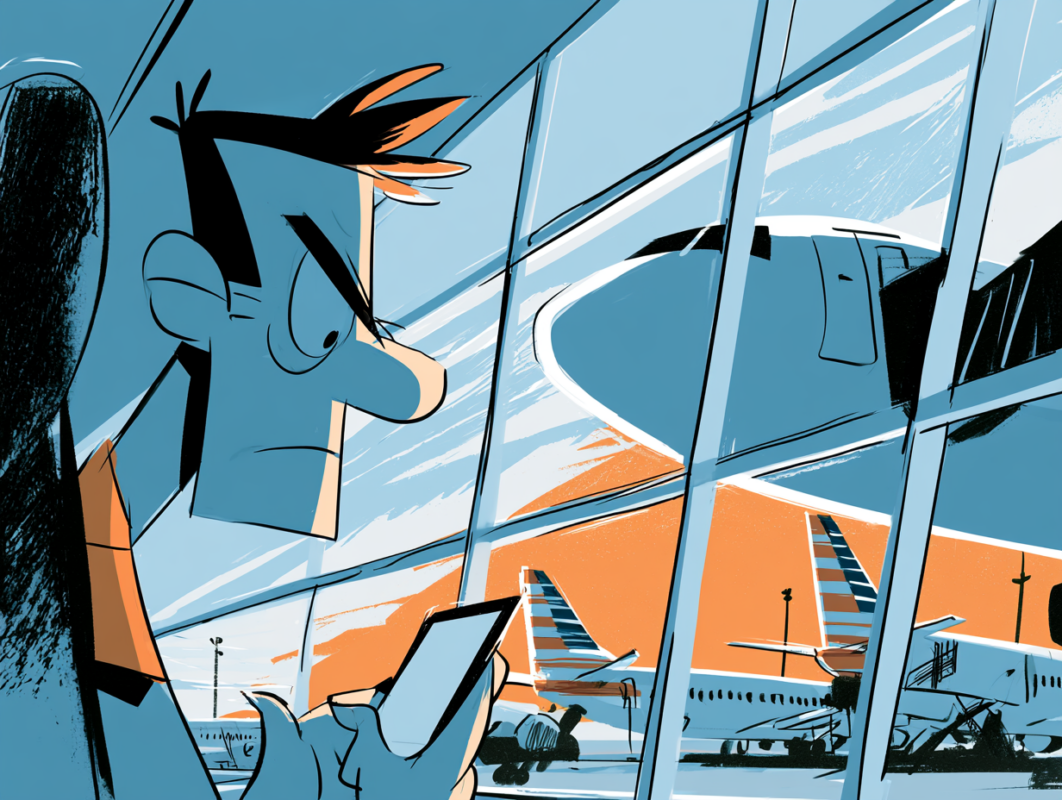
This just in: AI is deciding if you can’t make a flight connection and proactively rebooking you. It happened to an almost-famous American Airlines passenger recently.
Then again, maybe it’s not just in.
American says it launched its automated rebooking technology in 2023. The tool has been moving passengers off connections for three summers. What changed in August is who noticed.
Why you’re hearing about it now
This is the month when people who fly twice a year board a plane. They hit a delay, they discover how the system works and then they breathlessly report it.
That was the story when American Airlines changed Washington Post columnist Marc Thiessen’s flight schedule.
“Since when do you change my itinerary without asking?” he wrote in an indignant post on X to American Airlines.
Oh yeah, X—the place we all go for our news.
A day later, media consultant Beverly Hallberg replied that the same thing had happened to her on the same day, and that she had spent part of a long wait on the tarmac calling the airline to put her original booking back together.
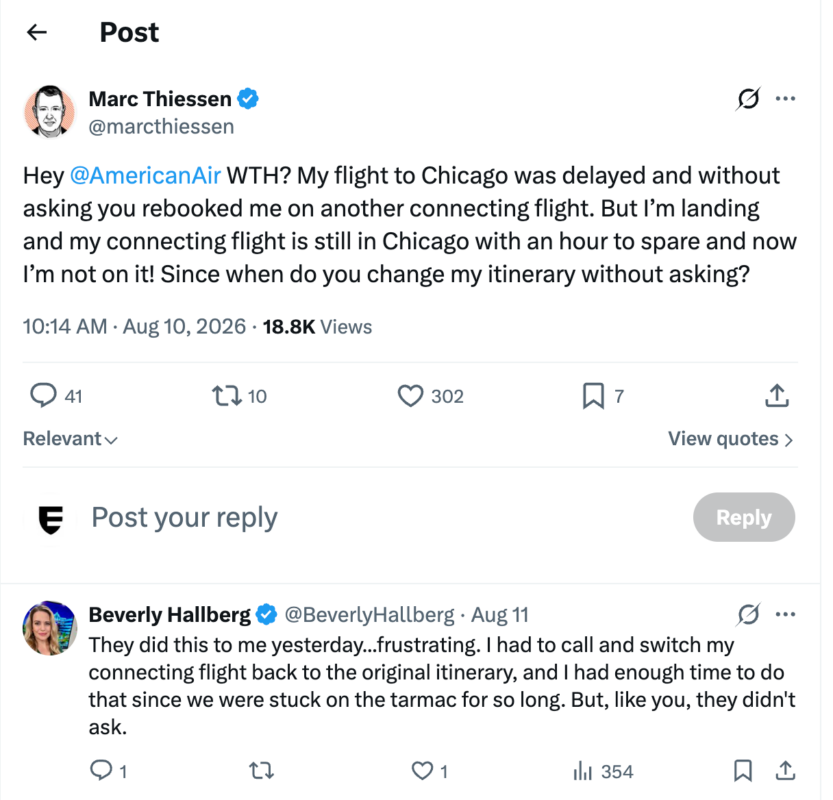
Disclosure: I spent 16 years as a Post travel columnist, and don’t know Thiessen or Hallberg, nor do I know how often they fly. But if you continue reading down the thread, you’ll see experienced air travelers telling him to stop complaining. The system saves time by accommodating passengers who wouldn’t make their connection and freeing up seats for other passengers.
How the system really works
American’s tool is called AURA, short for Automated ReAccommodation. It predicts which passengers are going to miss a connection and rebooks them before they do. The airline added a second piece of software, Connect Assist, at Dallas-Fort Worth and Charlotte about a year ago, and expanded it this year to Chicago, Miami, Philadelphia and Phoenix.
It isn’t perfect. After all, a late inbound doesn’t guarantee a missed connection, and planes make up time in the air. Connecting flights get delayed too, which is what happened to Thiessen and Hallberg. When the software guesses wrong, passengers can spend an afternoon on hold.
But the discussion raises an interesting question: Is this too much AI?
I have been third party to so many delayed flights and about to be missed connections that when an airline proactively protects a passenger on a following flight I (and the passenger) are just relieved. Would it be nice to be advised or asked? Sure, but when you’re on an arriving flight with no way to communicate, wouldn’t it be comforting to know that you won’t have to fight in a long line of other delayed passengers to get rebooked on an alternate flight?
Does anyone owe you anything for being rescheduled?
Not really. Federal rules on bumping, 14 CFR Part 250, cover passengers with confirmed reservations who are denied boarding from an oversold flight. When they apply, the money is real. An airline owes at least 200 percent of your fare, capped at $1,075, “if you get to your destination one or two hours late, and 400 percent, capped at $2,150, beyond that. It owes nothing if it reroutes you to arrive within an hour of your original time.
Neither of the August cases comes close to violating federal law. Thiessen kept flying. Hallberg got her seat back with a phone call. Nobody was turned away at a gate. (If you reach the gate on time and the airline gave your seat to another passenger, ask the agent directly whether you’ve been denied boarding involuntarily and get the answer in writing if possible.)
Wait, is this a customer service improvement?
American says the technology has cut the average delay to a customer’s final destination by 25 percent since 2023, and that it keeps refining the system. So the airline effectively knows where you’re going to end up before you do.
Nice to see the airline using technology to improve the customer experience instead of using it to optimize revenue, isn’t it?
Still, shouldn’t the airline ask us before rescheduling?
If you said yes:
- Would you still say yes if the software were less reliable?
- Should the airline have to notify you the moment it makes a change?
If you said no:
- Should you be able to decline automatic rebooking when you buy the ticket?
- Would you pay more to fly an airline that keeps a person in the loop?
My take
I’ve been writing about this technology for decades. I don’t think the objection here is the use of AI. Plenty of passengers want to be moved without having to ask, and they said so in public this month.
No, the objection is that the passenger is the only party to the transaction who doesn’t take part in the decision. You’re not allowed to argue with the AI. You bought a seat, but something else now holds the final say over whether you sit in it.
One reply to Thiessen claimed Delta rewrote a family’s itinerary in the air back in June, and that the family made the connection but lost the seats it had booked together. If predictive rebooking is dissolving family seating assignments across more than one airline, then this is much bigger than a newspaper columnist discovering three-year-old software.
Airlines have spent 20 years teaching us that the seat we bought is a suggestion. Everything from the overhead bin space to legroom moved from something you owned to something you paid extra for. Now the itinerary itself is becoming a suggestion, too.
Oh well. It was bound to happen sooner or later.
Your turn
Has an algorithm ever rewritten your trip? Did you get it back, and how long did it take? Our comments are open.

Have a question about this story? Tell us what happened — we read every comment.
Join the conversation