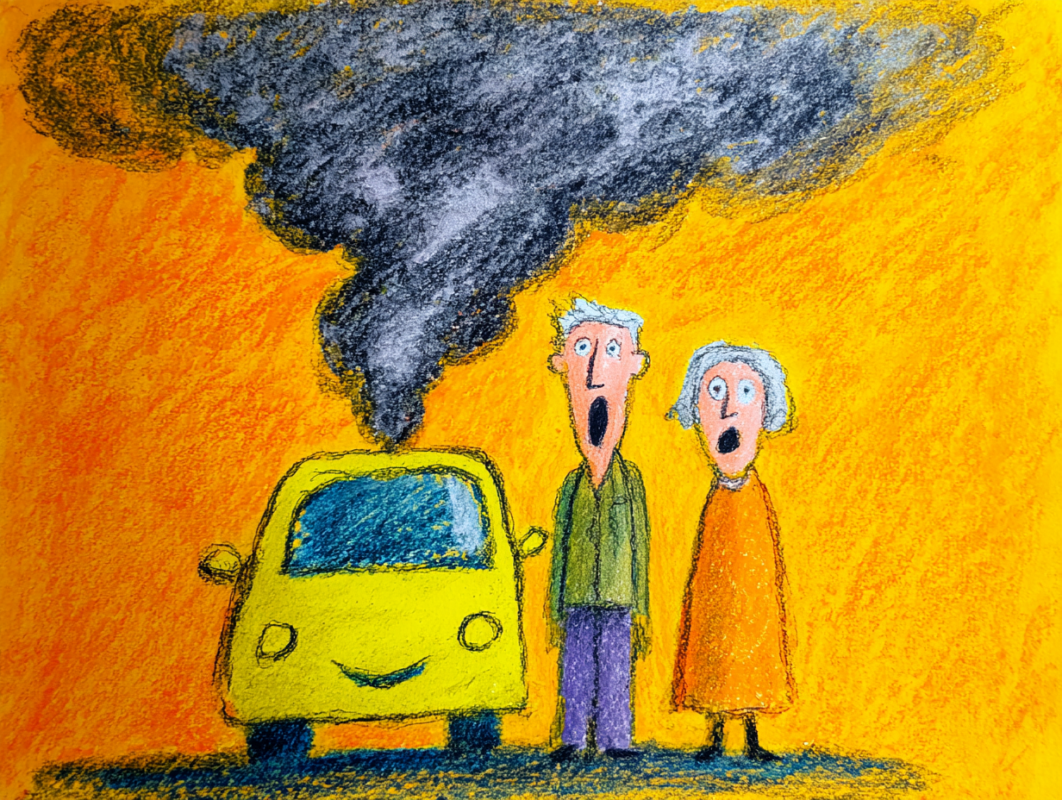
Have you heard about the car rental industry’s latest trick to pad its bottom line? You return a car, get a clean receipt, and then—sometimes days later—an email arrives claiming you turned the backseat into a cigar lounge.
Ray Oswald didn’t know about it until he and his wife, Denise, returned their Mazda CX-5 to Budget at O’Hare International Airport. They were in town to attend a family funeral. And this rental was handled by the book: They say they drove the car safely and returned it.
Oh, and they don’t smoke—and neither does their adult son, who was with them. Even so, Budget insisted the car smelled like a chimney and demanded $450 to clean the vehicle.
Seriously? Yes, seriously.
Their case raises several important questions:
- How do car rental companies prove a vehicle smells like smoke?
- What should you do if you’re charged for damage or cleaning you didn’t cause?
- Can a rental company charge you a fee after providing a clean receipt?
A few blurry photos—and a $450 charge
The Oswalds are still puzzled by what happened to them. When they returned the vehicle, an agent told them to leave the keys and that they were free to go. At the time, they received an e-receipt showing a total of $312. No mention of ash, no mention of odors.
Five days later, the Oswalds got some bad news. An email from the “ERS Billing Team” arrived with a $450 surprise for “excessive cleaning.” Budget claimed there was “smoke-related ash residue” and a heavy smell.
The evidence? A few blurry photos that Oswald says could have been taken inside any white Mazda.
“The pictures they attached did not show proof of their charges,” says Oswald. “I read online that many people have had similar instances of unjust excessive cleaning fees from Budget.”
That’s true. We’ve covered a few on this site, including $450 to clean floor mats and $450 for vacuuming a car. Seriously, folks, you can’t make this stuff up.
But the worst charge is for something you can’t even see.
How do car rental companies prove a vehicle smells like smoke?
Proving a smell is a bit like proving ghosts exist. It’s largely in the eye—or nose—of the beholder. In the case of the Oswalds, Budget relied on a vehicle inspection report filled out by an agent after the couple had already left the airport. The report checked a box for “Smoke Smell” and labeled the severity as “Heavy.”
The problem is that smell is subjective.
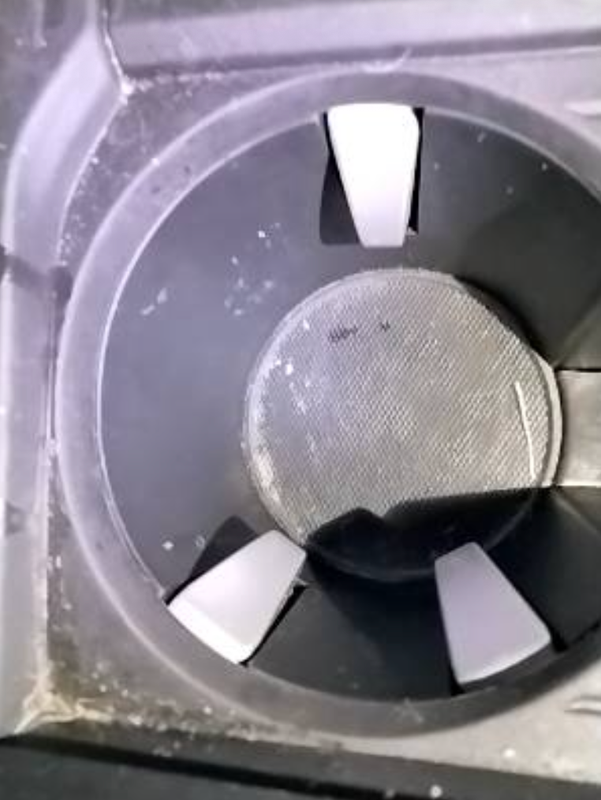
Picture of a cup holder allegedly taken in Oswald’s car. But this doesn’t prove a smoke smell.
Budget tried to back its claim up with photos, but as Oswald pointed out, the images showed nothing definitive. Unless there’s a photo of a lit cigar resting in the cup holder, a picture of a cup holder doesn’t prove a scent exists. Oswald noted the drop-off area itself was an underground garage with a high exhaust smell. It’s entirely possible the agent’s nose was just confused by the fumes—or from a cigarette smoke smell coming from somewhere else.
When a company charges a $450 cleaning fee, the burden of proof should be high. But rental companies often act as judge, jury, and executioner, using their own internal reports as proof.
If you find yourself in this spot, look at the metadata of the photos. Often, the photos provided aren’t even of the car you rented, or they were taken hours after you dropped it off. Oswald was correct to question whether the photos were even of his vehicle, since they lacked any identifying features like a license plate or a VIN in the frame.
I asked Oswald if he recognized the photos and he said he couldn’t be sure they were images of the car he rented.
What should you do if you are charged for damage or cleaning you didn’t cause?
If you get hit with a surprise cleaning fee, don’t just pay it. You may be dealing with a corporate bureaucracy that relies on most people being too busy to fight. To beat Budget—or any rental firm—at this game, you need to be more organized than its billing department.
The Oswalds’ first instinct was correct: they immediately challenged the premise of the charge. Oswald contacted the company and laid out the facts. But beyond just saying “we don’t smoke,” you need a tactical approach. Here is how you handle it:
- Demand the evidence immediately. When a company hits you with a fee, it must provide proof. Ask for the vehicle inspection report and any cleaning invoices. If Budget says it cost $450 to clean the car, it should have a receipt from a cleaning service showing that amount was paid. Often, these companies use a flat-fee “penalty” structure that bears no relation to the actual cost. If it can’t produce a third-party invoice, the fee is likely a profit center, not a reimbursement.
- Audit the photos. Most rental companies now provide photos as “proof” of smoking. Look at them with a skeptical eye. Check the metadata of the digital files if possible to see when and where they were taken. In the Oswalds’ case, the photos were of floor mats in a generic car. There was no VIN, no license plate, and no timestamp that proved the vehicle in the photo was the one they rented. If the photos aren’t clearly of your vehicle, tell the company you don’t recognize the car in the pictures.
- Check the timeline. This is where most rental companies trip up. If you returned the car at 8 a.m. and received a clean receipt, but the inspection report showing “smoke” wasn’t filed until 4 p.m., then the car was sitting in a lot for eight hours. Anyone could have opened the door, or a lot attendant could have moved it while smoking. A clean receipt at the time of return is your strongest weapon. It shows the company’s own agent signed off on the car’s condition.
- Escalate to the executives. Front-line customer service agents are often trained to just repeat the company’s position. They have no power to waive a $450 fee. If the initial appeal goes nowhere, move up the chain. You can find the names and email addresses of the executives at Avis Budget Group on my consumer advocacy site, Elliott.org. A polite, concise email to a vice president of customer experience often yields a much faster result than a dozen phone calls to a generic help desk.
- File a credit card dispute as a last resort. If the company refuses to provide evidence or ignores your emails, contact your bank. A credit card dispute forces the rental company to prove to the bank that the charge is valid. Since “smell” is subjective and many of these companies lack solid documentation, they often lose these disputes. But remember, winning a dispute can sometimes land you on the company’s Do Not Rent list.
The Oswalds were dealing with a heavy smoke allegation based on what they described as a garage-smelling environment. By refusing to accept the generic photos as proof and keeping the pressure on the operations team, they started a conversation that the company eventually had to take seriously.
Remember, the goal of these fees often is to see who will pay without asking questions. Once you start asking for timestamps, cleaning receipts, and VIN-specific photos, you become a difficult case. In the world of corporate collections, difficult often leads to a “one-time courtesy” refund just to make you go away.
But hang on: Is this kind of charge even legal?
Can a rental company charge you a fee after providing a clean receipt?
Technically, yes, but it’s a terrible business practice. When you return a car and get a receipt for $312, most reasonable people assume the transaction is closed. But the fine print in most rental contracts allows the company to audit the vehicle later and add charges for damage or cleaning.
The Oswalds received their receipt five days after returning their vehicle. During that time, the car could have been moved, cleaned, or even rented to someone else.
To protect yourself, you need your own evidence. I always advise readers to take 360-degree photos and a quick video of the interior and exterior of the car at drop-off. If the Oswalds had a photo of the clean vehicle from the moment they handed over the keys, this would have been an open-and-shut case. Without those photos, it’s your word against a company that has already taken your money.
Will they get a refund?
Budget had the Oswalds’ credit card number and a report from an agent claiming the car was a biohazard. The Oswalds had their integrity and a receipt that said they were good to go. It looked like a stalemate that would end in a credit card dispute—unless I did something.
I contacted Avis Budget Group on behalf of the Oswalds. And I pointed out that the renters were non-smokers and that the evidence provided by the local office was, shall we say, less than convincing.
The resolution? Budget says it conducted an internal investigation that resulted in a full refund of the $450 cleaning fee. An Avis representative even extended an apology, stating the experience “was not typical” and that they were taking “corrective actions” with the local manager.
Look, it shouldn’t take a nationally syndicated columnist to get a rental company to realize that two people in their late 60s attending a funeral probably weren’t hot-boxing a Mazda. But in the world of advocacy, sometimes you have to blow a little smoke back at the companies to clear the air.

Have a question about this story? Tell us what happened — we read every comment.
Join the conversation