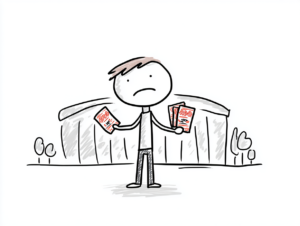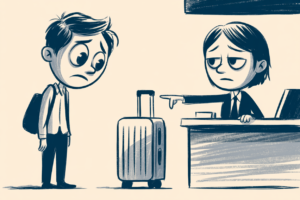
It’s every airline passenger’s worst nightmare: You’re about to board a flight when an airline agent stops you. You’re not flying today—in fact, you’ll never fly on the airline again.
It happened to Athena Smith when she tried to fly from Fort Lauderdale to Hartford on JetBlue. As she was waiting to get on the plane, an agent approached her and said she couldn’t fly that day because she’d used an expired travel bank voucher to book her reservation.
If she didn’t pay $468, she would be banned from JetBlue forever.
Smith is the latest victim of a sophisticated airline ticket scam in which a shady third-party site takes your hard-earned cash, then turns around and pays the airline with a stolen or fraudulent voucher. The airline gets its money back when the real owner of the voucher reports the theft, and you? You get the boot.
This case raises several important questions:
- How can I get unbanned from an airline?
- How do I spot a travel booking scam before I pay?
- What should I do if my travel agent goes silent after a problem?
If the airlines charged everyone the same fare for a seat, scammers’ fake prices would stand out like a sore thumb.
“I had no clue what he was talking about”
Smith travels at least twice a month from Hartford to Fort Lauderdale to care for her 95-year-old mother. JetBlue is the only carrier that offers a nonstop flight for that route, making it her go-to airline. But as she prepared to board her recent flight home from Florida, a JetBlue official intercepted her.
The airline claimed she owed money for an “outstanding travel bank voucher” used on a previous reservation.
“I had no clue what he was talking about as I had never used a voucher but paid via credit card,” Smith told me.
JetBlue had more bad news: Until she paid for her ticket, she was banned from flying on its planes.
How did this happen? The trouble started with a site called Farehub, she says. Smith used her credit card to book a round-trip ticket for $468. She has the statement to prove it.
But JetBlue’s records told a different story. According to the airline, the ticket was purchased with a JetBlue Travel Bank credit voucher—one that didn’t belong to Smith.
“What is puzzling is that JetBlue’s records indicate that the form of payment was a fraudulent travel voucher,” Smith said. “Presumably Farehub would have submitted the credit card payment to JetBlue.”
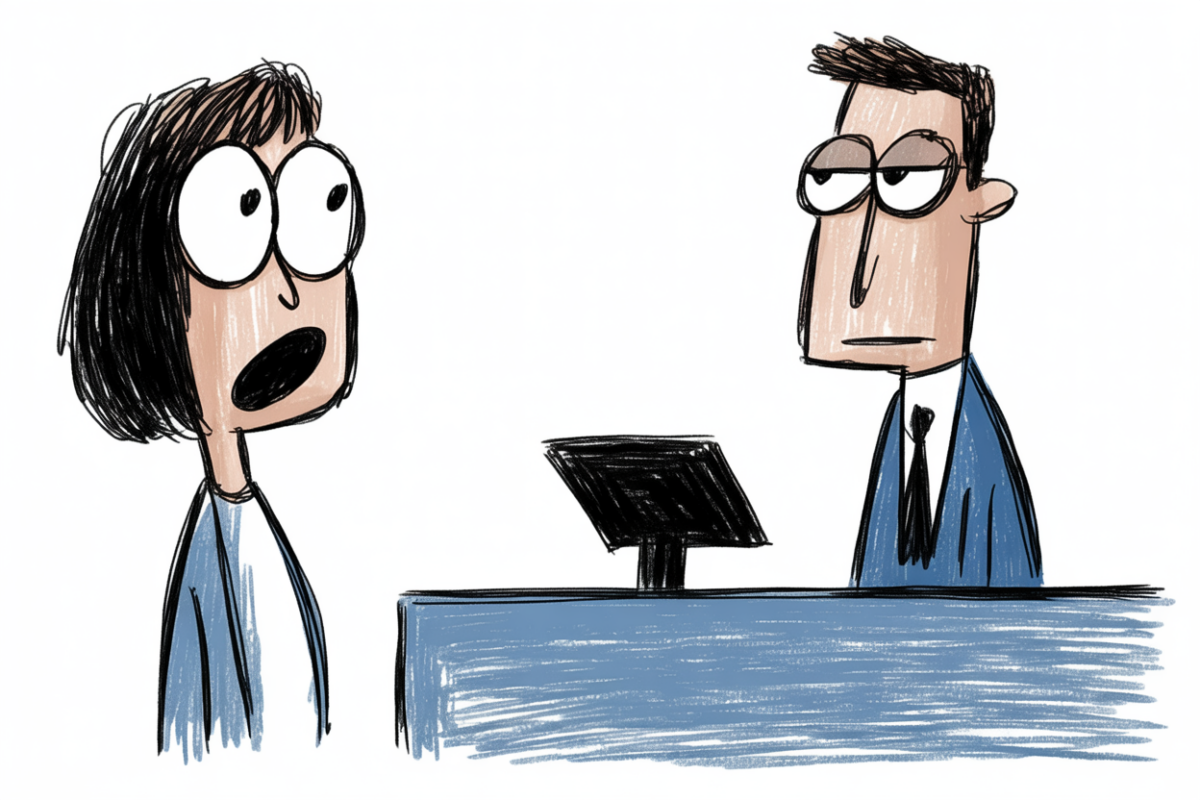
When Smith tried to contact Farehub, the company went silent. She tried WhatsApp, emails, and phone calls.
“Either customer service deliberately hangs up on me or does not return my phone calls,” she said.
She was stuck in a classic squeeze play. She had paid for a ticket, the airline said it was stolen, and the middleman had vanished into a digital haze. Desperate and banned from the only airline that could get her to her mother non-stop, she reached out to my team for help.
Would JetBlue see reason, or would it continue to hold Smith responsible for a third-party scam?
How can I get unbanned from an airline?
Getting banned from an airline is usually reserved for people who try to open emergency exits at 30,000 feet. But lately, carriers are using the No Fly list as a high-pressure debt collection tool. When an airline bans you for a financial discrepancy, it’s about leverage.
To get unbanned, you first have to identify which department holds the keys to your freedom. Usually, it isn’t the front-line customer service agents or the people at the ticket counter. You need the risk management or corporate security department. These are the folks who look at spreadsheets and see fraud where you see a family vacation.
In Smith’s case, JetBlue’s travel bank team flagged the reservation. When a ticket is identified as fraudulent, the airline’s internal system automatically blacklists the passenger associated with the passenger name record. (Although it would be nice if they notified passengers before they got to the airport.) To reverse this, you must provide a preponderance of evidence—a fancy legal term for proving you aren’t a crook.
Specifically, that means you need your original credit card statement showing the charge from the travel agency, the confirmation email from that agency, and a clear explanation that you are a victim of a third-party scam.
If the airline still refuses to budge, and if there’s no way to contact the ticket agent, you have to escalate. I recommend sending a polite email to the airline’s executives. We publish the names and numbers of JetBlue’s executives on this site.
As you can imagine, airlines take a dim view of these third-party sites and the people who use them. They often take the position that because you benefited from the transportation, you owe the money, regardless of who you paid. If they refuse to communicate, your only leverage is public advocacy or legal action, which can be more expensive than the debt itself.
How do I spot a travel booking scam before I pay?
The internet is a dark ocean of shady deals and, unfortunately, many of them are lures set by digital pirates. Scammers create professional-looking websites that mirror legitimate agencies. They use search engine optimization to appear at the top of your Google results when you search for “cheap flights to Fort Lauderdale.”
The first red flag is the price. If every major airline is quoting $500 and a site you’ve never heard of is offering $350, it’s probably a trap. These sites often operate a “bust-out” scheme. They take your credit card info, book your flight using a stolen voucher or a compromised corporate account, and pocket your cash. By the time the airline realizes the voucher was stolen—which can take weeks—the scammer has shut down the site and moved to a new domain.
The “contact us” page warning. If there’s no physical address, or if the address is a PO box in a country you can’t find on a map, run away.
Shady payment methods. If a site asks you to pay via Zelle, wire transfer, or cryptocurrency, it’s a scam. Legitimate agencies take credit cards. But that’s no guarantee, as Smith discovered. Even paying with a credit card doesn’t protect you from being banned by the airline if the agency uses fraudulent means to settle the back end of the transaction.
Before you click “buy,” search for the site’s name plus the word “scam” or “complaints.” And remember, you’re almost always better off booking directly.
What should I do if my travel agent goes silent after a problem?
The silent treatment is a classic move for bottom-feeding agencies. Once they have your money and the airline flags the fraud, they have no incentive to help you. In fact, talking to you only increases their risk of being caught.
If your online travel agent goes MIA, your first move is a credit card chargeback. Under the Fair Credit Billing Act, you have the right to dispute charges for services not rendered.
Since the airline is refusing to let you fly because the agent didn’t pay them properly, the agent has failed to provide the service you bought. Call your credit card company immediately. Don’t wait. There’s usually a 60-day window to file a dispute. Here’s more information on credit card disputes.
While the chargeback might get your money back, it won’t fix your relationship with the airline. For that, you need to act as your own advocate. Gather every scrap of paper—emails, chat logs, bank statements—and present them to the airline as proof that you were defrauded by the agency. Smith did exactly this, keeping a meticulous record of her attempts to contact Farehub.
If the agent is a member of an organization like the American Society of Travel Advisors (ASTA), you can file a formal complaint. But let’s be real: the Farehubs of the world don’t join professional organizations. They exist in the shadows. When they go silent, your best bet is to stop chasing the ghost and start working the airline’s corporate ladder. If the airline ignores you, it’s time to call in the cavalry.
Our advocate, Dwayne Coward, reached out to JetBlue on Smith’s behalf. He presented the evidence of the Farehub transaction and the credit card statement. He explained that Smith was a victim, not a perpetrator.
The response? Nothing.
He reached out again, and again, he got radio silence.
Finally, as I was preparing to write this story, I contacted JetBlue.
“We’ve shared the note with our support team who will be reaching out directly to the customer to gather additional details and help advise her on options to ensure she’ll be able to fly with us in the future,” a representative told me.
JetBlue also said it encourages customers to visit its site “for the best experience and fares” and if you’re booking through a third party, “be cautious of unknown or unverified resellers offering deals too good to be true.”
“While we work with the rest of the industry to proactively try to stop fraudulent travel agencies, new sites, unrelated phone numbers, and social media profiles do pop up online attempting to steal and use your personal and financial information,” the representative added.
I followed up with Smith and she said JetBlue had been in contact with her to restore her flying privileges. Unfortunately, JetBlue would not refund her money. For that, she turned to her bank, which promptly accepted her credit card dispute and refunded the money.
Here’s the thing: JetBlue knew—or should have known—about Farehub. But it’s easier to shake down a caregiver for $468 than it is to chase a ghost in a digital shell game.

Have a question about this story? Tell us what happened — we read every comment.
Join the conversation