Black and white cartoon of a cruise ship docked beside a high prison wall topped with razor wire and a guard tower.

The FBI wants you to report cruise crime. Then what?

The FBI has a message for cruise passengers as vacation season begins: if you are assaulted, kidnapped, or sexually assaulted at sea, report it right away. It is good advice. Of course you should report a crime. But the announcement leaves out what happens after you speak up. The law meant to track crime at sea, passed in 2010, counts only a short list of the most serious categories. Its requirements generally reach incidents involving U.S. nationals, which leaves out most crew members and plenty of passengers. Thefts count only above a dollar threshold. And an assault is reportable only if it causes “serious bodily injury,” a term the law never defines, which turns a beating into a judgment call. Here is the part that deserves a longer look: the FBI tells passengers to report incidents to the cruise line, and the cruise line is the one that reports them to the government. A company sells you a safe vacation, then helps decide whether what happened to you counts as a crime worth counting.
Black and white cartoon of a puzzled traveler with a question mark overhead watching two airplanes fly away in opposite directions.

America and Europe just went opposite ways on airline fees. Who’s right?

How much of an airline ticket’s price do you deserve to see when you shop for a flight? The United States and Europe just answered that question within days of each other, and came to opposite conclusions. In America, a rule that would have required airlines and booking sites to show you the cost of a checked bag or a ticket change the first time a fare appeared never survived. A federal appeals court blocked it before any airline had to comply, then threw it out entirely, faulting the government for skipping a step rather than finding fee transparency unlawful. Instead of redoing the rule, regulators made the defeat official and restored the older standard: airlines note that fees may apply and point you toward the fine print. Europe went the other way, approving its first overhaul of air passenger rights in more than two decades, with fares that must include the cost of a standard carry-on from the outset. Airlines argue that unbundling lets travelers who skip the extras pay less, and that every mandatory fee is disclosed before you buy. Consumer advocates counter that a fare hiding the bag charge is not really a price at all.

Cartoon of a weary couple driving a car down a straight desert highway lined with cactuses at sunset, as an airplane flies overhead.

American Airlines delayed my flight, so I drove. Why can’t I get a refund?

Michael Damarino and his wife thought they had done everything right. They booked refundable American Airlines tickets through Expedia from Boston to Tucson by way of Phoenix, paying extra for the flexibility. Then a 90-minute delay in Phoenix, blamed on a sick first officer and a baggage weight problem, made them miss their connection. With no later flights available, they did the resourceful thing: they rented a car and drove the final 100 miles so they would not lose their vacation. What they did not realize is that solving the airline’s problem themselves had quietly turned them into a “no-show” for that last leg. In the airline’s system, skipping a flight without canceling it first triggers a clause that can cancel the rest of your itinerary and wipe out the ticket’s value, even when you paid for a refundable fare. American offered only a flight credit and called the ticket nonrefundable. Expedia pointed back to the airline, and the airline pointed to Expedia.

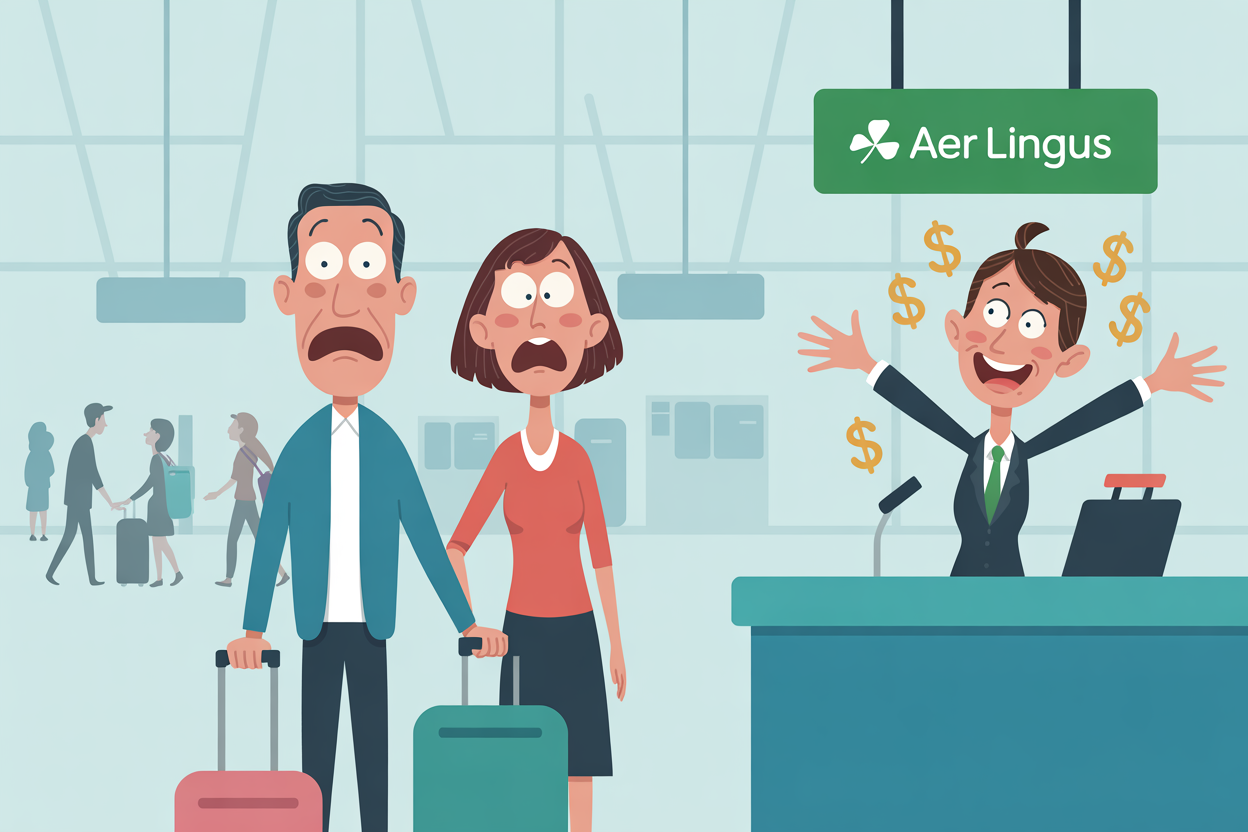
Cartoon of a shocked couple with rolling suitcases at an airport as a grinning airline agent throws up his arms amid floating dollar signs beneath an Aer Lingus sign.

My airline ticket disappeared. Why did I have to pay $8,206 to get home?

Steve Miller thought he and his wife had valid tickets home. He had booked a Minneapolis-to-Dublin roundtrip through Orbitz, and when Aer Lingus canceled a segment, Orbitz rebooked them and confirmed the new itinerary. The My Trips page showed the change. The Aer Lingus app showed them booked. Everything said they were good to go. Then, at the gate in Dublin for the flight home, Aer Lingus refused to let them board, saying Orbitz had never properly confirmed the change. It turns out there is a critical difference most travelers never think about: a reservation holds a seat, but a ticket is the payment for it, and you can have a confirmation code with no valid ticket behind it. In the airline’s computer, the couple existed as passengers who had not technically paid. Stranded overseas and needing to get home that day, Miller was told the only seats left were in business class, at a price that ran into the thousands.

Muted digital illustration of a distressed man in a suit sitting with his head in his hands at an airport, blurred travelers passing behind him.

The $1,863 mistake: Why a missing last name cost one passenger his ticket

Saurabh Kumar had a passport, a plane ticket, and a plan to visit family in Delhi. He was good to go, or so he thought. The trouble was hiding in plain sight on his passport: his full name sits in the given-name field, and the surname line is blank. That is ordinary in parts of the world, but a headache for Western airline systems that insist on a last name. When Expedia’s booking form demanded one, Kumar did what most people would do, he split his name into a first and a last and clicked buy. He had done it before and flown without a hitch. This time, at the Toronto airport, the Porter Airlines computer stopped him cold. The name on his ticket did not match the name on his passport, and to a security system built to screen millions against international watchlists, close enough is not enough. Porter said only the ticketing airline, Qatar Airways, could authorize a fix. Qatar was not at the counter. And the clock was running out.

Cartoon of a grinning car salesman with a cash-filled thought bubble gesturing toward a white SUV as a customer stands with arms crossed at a dealership lot.

How to get the car you reserved without falling for the upsell scam

Have you ever heard of the car rental upsell scam? Neither had Steve Sphar. When the business consultant from Sacramento arrived to pick up a compact car from Europcar in Granada, Spain, the company had run out of vehicles. So it handed him an SUV and said he could swap it for his reserved model the next day, a seemingly generous fix. Then he made the swap, and Europcar charged him a $423 “customer choice” fee. It looks like a clever variation on an old rental-counter ploy, and experts say it is spreading as fleet shortages and inflation squeeze the industry. Running out of cars and then charging extra for a bigger one is legal, they note, but that does not make it right. The industry standard when a company oversells is simple: upgrade the customer for free. Some companies, though, see an oversold lot as an opportunity, offering two bad choices, wait for hours or pay a ransom, and betting you will not want to delay your vacation. Sphar contacted Europcar to reverse the charge.

Black and white cartoon of an annoyed traveler with a rolling suitcase glaring at an airline agent behind a check-in counter.

You’re mad at the wrong machine

Does the TSA want to measure your luggage? You might think so after a viral aviation report warned that the agency’s newer 3D scanners have smaller entry tunnels than the old X-ray machines, and that an oversized carry-on might not fit, potentially sending you back to the counter to check it. Travelers connected the dots fast: the government as the airlines’ baggage enforcer, turning every overpacked bag into a checked-bag fee. It is a textbook case of decoy outrage, a fake scandal that soaks up all the anger a real one deserves. The tunnels are indeed smaller, and the TSA advises asking a screener for help. But there is no algorithm flagging a bag an inch too wide, and no documented wave of passengers being marched back to pay up. If your bag fits and passes screening, it flies. The scanner panic is a non-story. The question it accidentally raises, about a government that already helps airlines keep the true cost of flying out of the advertised price, is not.

Cartoon of a distressed woman standing at her front door, hands to her face, as a UPS driver stands by his truck with his hands raised in an empty-handed shrug.

Michael Kors and UPS are playing hot potato with my $687 refund — how do I win?

Lina Mahmoud’s $687 Michael Kors order never showed up. UPS investigated, declared the package lost, and confirmed in writing that the refund should come from the shipper, Michael Kors. That should have settled it. Instead, Michael Kors refused, pointing to a proof-of-delivery photo that, she says, does not clearly show her package at all. She was told the claim was denied and that this was the final answer, and when she kept pushing, she says customer service agents began disconnecting her live chats. She was left feeling as though the company now viewed her as a fraud, caught in a game of corporate hot potato: the carrier says the retailer owes the money, the retailer hides behind a questionable image, and the customer is stuck in the middle. It is a stark reminder of how much the burden of proof can fall on the shopper when a package goes missing, and of what recourse you really have when the standard customer-service channels simply stop answering.

Cartoon of a shocked woman standing between two twin beds with visibly stained sheets in a hotel room, a city skyline through the window behind her.

They advertised two queen beds and a clean room. I got neither—and a $922 charge.

Rebekah Singleton booked a room with two queen beds at a Brooklyn hotel through Booking.com because she specifically needed the queen beds. What she got was something else entirely. The beds measured out to roughly 50 inches wide, a full size, not a queen, and the room itself was filthy: sheets marked with grease stains, hair, and what looked like suspicious red stains. The second room she was offered was worse, with red splatter across the floor. She did not feel safe, so she left that night and found another hotel. Then the real ordeal began. The hotel denied her photo evidence. Booking.com dragged the matter out for weeks and offered only a small goodwill credit. She disputed the $922 charge with her credit card, which briefly credited her before rebilling the entire amount once the merchant pushed back. She was left out nearly a thousand dollars for a room she never used, caught between a property, a platform, and a card issuer, each pointing elsewhere, and left asking what a booking site actually owes you when the room it sold bears no resemblance to the one you paid for.

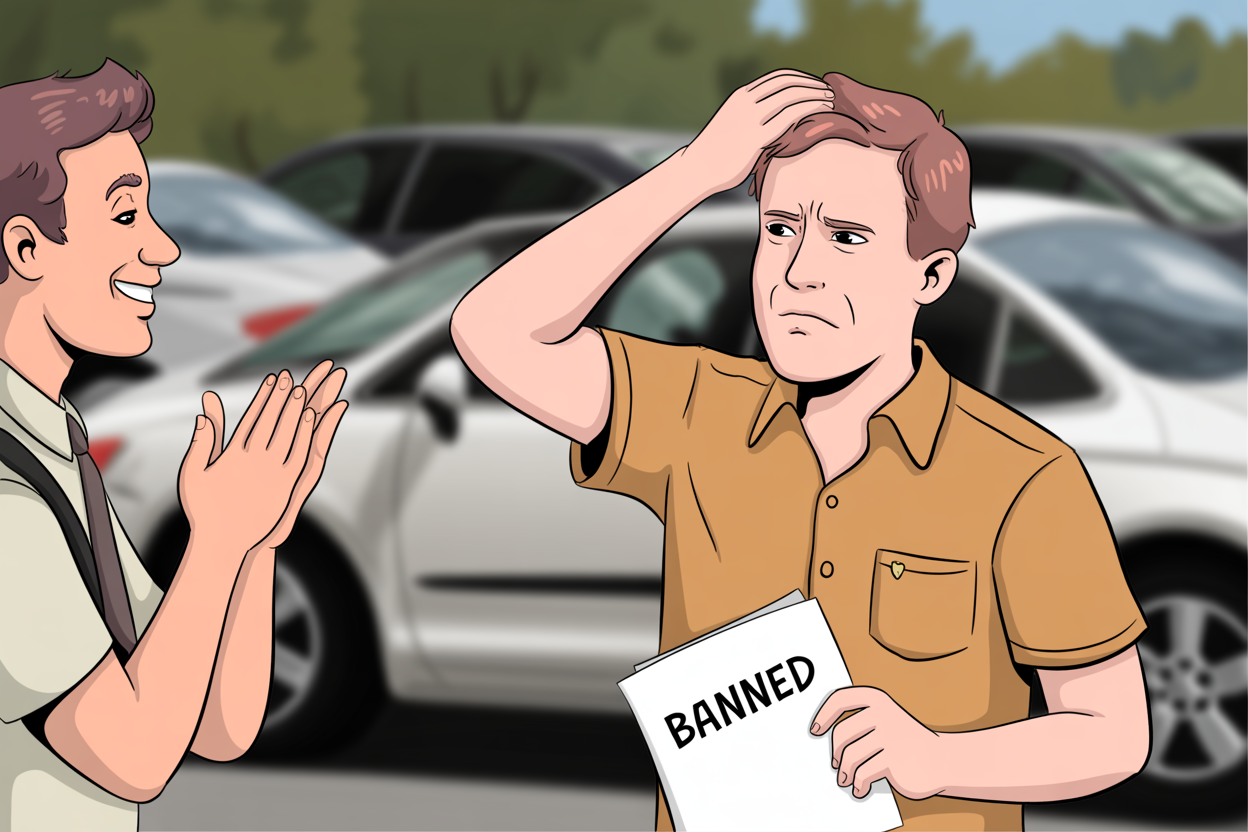
Cartoon of a distressed man holding a paper marked "BANNED" and clutching his head in a rental car lot, while a smiling rental agent gestures beside a row of cars.

Banned for a century: How one driver beat the car rental blacklist

Carlos Brown walked up to the rental counter in Cleveland expecting a car. Instead, he got a lifetime ban. A state transportation specialist who had rented dozens of cars that year alone, every payment cleared and every car returned without a scratch, Brown watched the agent’s computer crash, heard her read his license details to headquarters, and learned in that moment that he was on the company’s Do Not Rent list. His loyalty account was terminated on the spot over a mistake from years earlier. Brown’s case pulls back the curtain on the hidden world of rental car blacklists: proprietary “Do Not Rent” lists that can bar you from every brand a company owns. The reasons vary, from unpaid bills to damage claims to simply being rude to an employee, and unlike your credit report, you have no legal right to see the file or dispute it. The Federal Trade Commission does not regulate these lists. Companies do not have to give you a hearing. They can just say no.