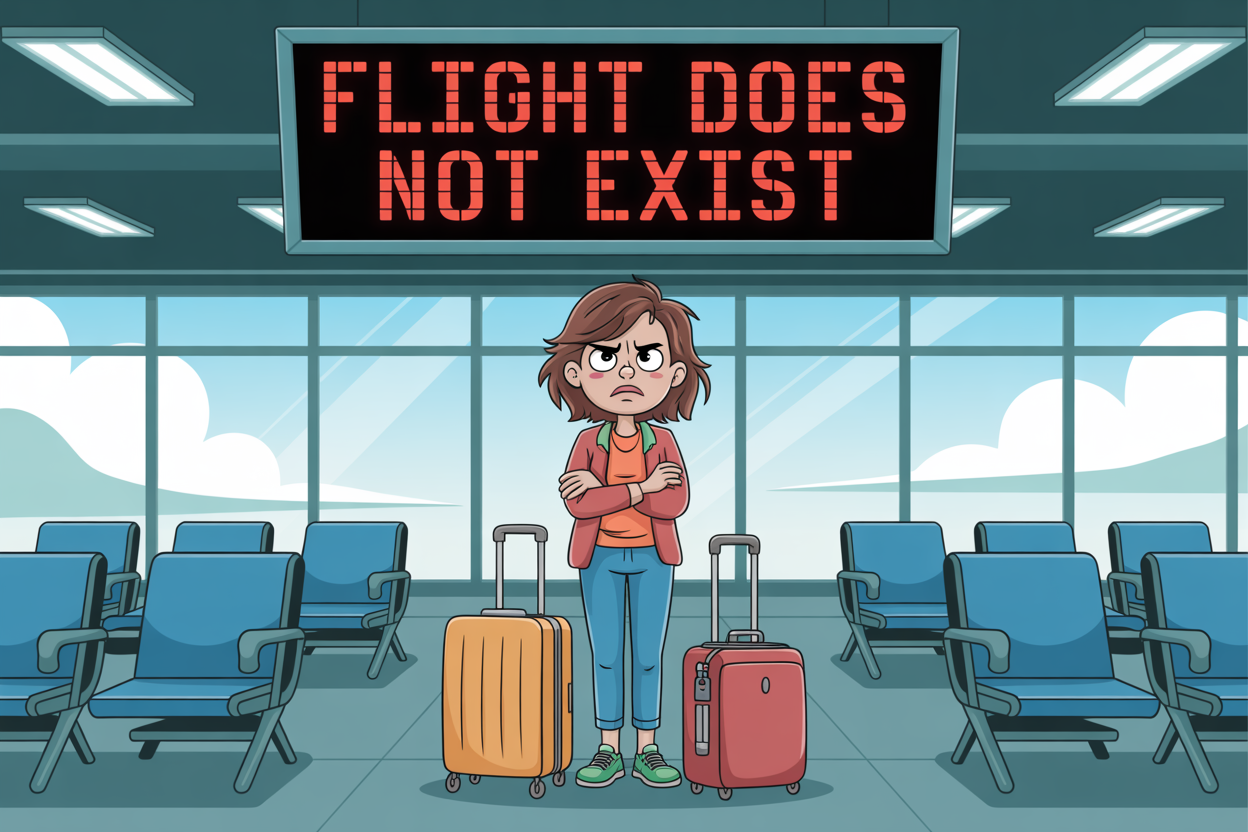
Cartoon of a frustrated traveler with arms crossed standing between two suitcases in an empty airport gate area, beneath a large red departures sign reading "FLIGHT DOES NOT EXIST."

Booking.com said my flight was confirmed, but the airline says it never existed

Lindley Kinerk’s last morning in Dresden seemed routine. She and her companions packed up, checked out, and headed to the airport for their 8:25 a.m. flight home to Boston. They had even gotten a friendly check-in reminder from Booking.com the night before. Then they reached the counter and learned something that would cost them nearly $6,000: their flight did not exist. Not that morning, not any morning. It had been off the airline’s schedule for months. Booking.com, it seems, had quietly rebooked them on an earlier flight and never said a word, and the airline insisted the whole thing was not its problem. With a third ticketing agency tangled into the booking and every company pointing at the others, Kinerk had to buy new tickets on the spot just to get home. What she did next, and what Booking.com eventually said about her money, is where this case turns.

Simple hand-drawn Bauhaus-inspired minimalist illustration on a white background showing a black line-drawing of an airplane taking off on the upper left and a small black line-drawing of a car on the lower right, separated by a single bold red diagonal line running corner to corner, symbolizing the widening divide between affluent air travelers spending more per trip and budget-conscious travelers priced out of summer vacations this year

The summer travel divide: How to find affordable vacations this year

Summer travel intent has hit its lowest point since the pandemic. Deloitte’s latest summer travel survey found only 45 percent of travelers plan a summer vacation with paid lodging this year, the lowest figure in six years. Travel intent fell across every income bracket, but the drop among households earning under $100,000 was twice as steep as the decline among middle- and high-income earners, an 8-point drop versus 4 points each. The travelers still going plan to spend $4,069 on their summer vacations, up 17 percent from last year. Deloitte’s broader 2026 outlook calls this a bifurcation of standard and luxury travel and frames competition for the high-spending traveler as one of the year’s defining trends. Travelers earning between $100,000 and $199,000 show the biggest booking gap, with 37 percent fully booked versus 45 percent last year, leaving a large amount of unsold late-May inventory that revenue managers are aware of.