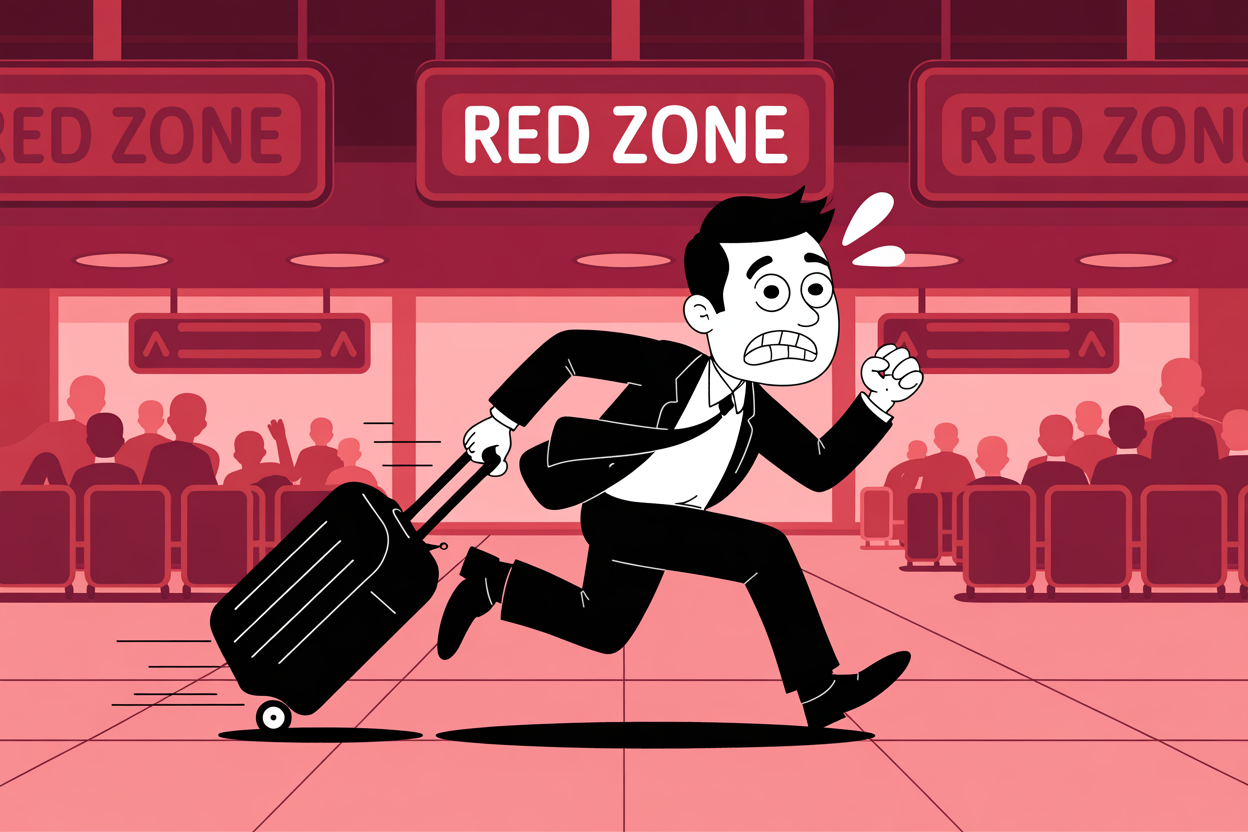
Cartoon of a panicked business traveler in a suit sprinting through an airport terminal dragging a rolling suitcase, with large RED ZONE signs overhead and a tense crowd waiting behind him.

The red zone: Why this part of air travel makes even the pros lose it

The red zone is that anxious stretch from your front door to your airplane seat, where normal people turn into nervous wrecks. It is a blur of high-stakes, time-sensitive decisions that overloads your brain, and it is stressful enough that most couples in one recent survey called travel the ultimate relationship test. It has even given rise to the airport divorce, where partners deliberately separate after security just to avoid an argument. We have all seen it: the passenger shouting at a gate agent over a delay, the family sprinting through the terminal with shoes half on, the quiet sob at the gate when a flight is canceled. With air travel booming this summer, the red zone is only getting more intense. There is real science behind why a security line can hijack your nervous system, and the surprising part is that even the most seasoned travelers, the ones with passports full of stamps, are not immune to it.

Minimalist black and white cartoon of a lone traveler with a rolling suitcase standing outside a nearly empty airport terminal, looking uncertain, evoking a trip thrown into limbo.

Let’s keep politics out of your summer vacation

Steve Brody is flying out of Newark this week, and he is worried. There are plans afoot to pull the Customs and Border Protection officers out of airports in certain cities, with Newark Liberty International first in line. Brody, a retired government worker, is flying nonstop to Vancouver, but he has to pass back through US Customs on his return. “Gimme strength,” he says. He is not being dramatic. Customs officers are the people who let you back into the country, and pull them out and international flights cannot unload their passengers. That is the part that should bother everyone, left, right, and undecided. A passport does not have a party affiliation. When a flight gets canceled, the system does not check your voter registration before it strands you. You are stuck. Which is the real question worth sitting with before your next trip: whether the airport you are counting on this summer should ever be something an administration is allowed to switch off to win an argument that has nothing to do with you.

Black and white cartoon of a woman with wild, disheveled hair glaring angrily near an airport check-in counter as a wary uniformed agent watches her from behind the desk. airline blacklist

Is it time for an international blacklist of problem passengers?

If an airline bans you for screaming at a flight attendant or trying to open a door at altitude, you can usually walk to a competitor’s counter and buy a ticket. Britain wants to put an end to that, and its actions may ripple across the Atlantic. The Department for Transport and the Home Office are reportedly working on a national system that would let UK airlines share details of serious offenders, so a person barred by one carrier could be flagged at check-in by another. A trade group has welcomed it, and a budget carrier has been lobbying for exactly this kind of database. On its face it sounds like common sense: keep the dangerous few off everyone’s planes. But a shared ban list raises harder questions than the headlines admit, starting with the ones that decide whether it protects passengers or quietly turns into something else: who decides who belongs on it, what counts as unruly, and if an airline flags you and you think it is wrong, who exactly do you appeal to?

Fear of travel is at a high, but the data tells a different story. Here's why your summer vacation is still a safe bet, from peace rankings to airline risk.

No, your summer vacation isn’t going to kill you

Fear of travel is running high this summer. A reader named Cindy Smith nearly canceled a Danube river cruise and a week in Croatia after reading headlines about a cruise hantavirus outbreak and crew arrests. She is not alone. In a recent Global Rescue survey, less than 1 percent of respondents said their concerns about personal safety abroad had eased since last year, while 56 percent said they felt more concerned. Travelers cite three recurring fears: airlines collapsing mid-trip, dangerous conditions abroad, and anti-American sentiment. Yet the major U.S. carriers such as Delta, United, American, and Southwest remain profitable, and a conflict on one side of a continent does not make the other side unsafe.

Simple hand-drawn Bauhaus-inspired minimalist illustration on a white background showing a black line-drawing of an airplane taking off on the upper left and a small black line-drawing of a car on the lower right, separated by a single bold red diagonal line running corner to corner, symbolizing the widening divide between affluent air travelers spending more per trip and budget-conscious travelers priced out of summer vacations this year

The summer travel divide: How to find affordable vacations this year

Summer travel intent has hit its lowest point since the pandemic. Deloitte’s latest summer travel survey found only 45 percent of travelers plan a summer vacation with paid lodging this year, the lowest figure in six years. Travel intent fell across every income bracket, but the drop among households earning under $100,000 was twice as steep as the decline among middle- and high-income earners, an 8-point drop versus 4 points each. The travelers still going plan to spend $4,069 on their summer vacations, up 17 percent from last year. Deloitte’s broader 2026 outlook calls this a bifurcation of standard and luxury travel and frames competition for the high-spending traveler as one of the year’s defining trends. Travelers earning between $100,000 and $199,000 show the biggest booking gap, with 37 percent fully booked versus 45 percent last year, leaving a large amount of unsold late-May inventory that revenue managers are aware of.

Editorial illustration showing four silhouetted figures with their hands raised to their heads in confusion or doubt, standing on concentric ring patterns and looking up at a large dark-blue globe of Earth with a giant white question mark hovering in front of it, illustrating how travelers are increasingly questioning the recommendations of professional travel experts in an age of paid influencers and commission-driven advice

Travelers are ignoring the advice of professionals. Here’s why that could be a mistake.

Travelers are increasingly skeptical of professional advice, ignoring travel agents who collect commissions, influencers paid by destinations, and points bloggers earning kickbacks from credit card companies. A Global Rescue survey shows 85 percent of travelers are concerned about geopolitical instability yet proceed with their plans despite the risks. Cautious skepticism is healthy when evaluating tourism-engine search results and influencer endorsements that dominate Google’s first page. But ignoring U.S. State Department advisories at Level 3 reconsider travel or Level 4 do not travel can lead to serious consequences. The chief medical officer at AXA Partners US says many travelers contract serious diseases and traumatic injuries in risky locations that were easily avoidable by following government advisories.