Black and white cartoon of a small couple with suitcases standing on a dark horizon, watching a paper airplane folded from a banknote fly up and away into a vast cloudy sky.

Air travelers deserve stronger consumer protections—in Europe and the U.S.

Mila Schoun knew what his downgrade was worth, but his airline pretended it did not. Schoun and his wife had paid Swiss International Air Lines for premium economy on a flight from Prague to Miami, and then the airline changed aircraft and put them in regular economy for the 10-hour crossing. He asked for the difference back. Swiss refused. What Schoun had on his side, even if he had never heard of it, was EC 261, a 21-year-old European regulation that makes airlines pay when they cancel, bump, strand, or downgrade you, and that quietly protects millions of Americans on any flight leaving an EU airport. Europe just spent the spring fighting over whether to gut that law, with the airline lobby pushing to raise the delay threshold and erase most claims. Passengers appear to have dodged the worst of it. But there is a quieter problem that no one in Brussels lobbied for and no one fought against, one that has been draining the value out of this protection for two decades while everyone argued about something else.

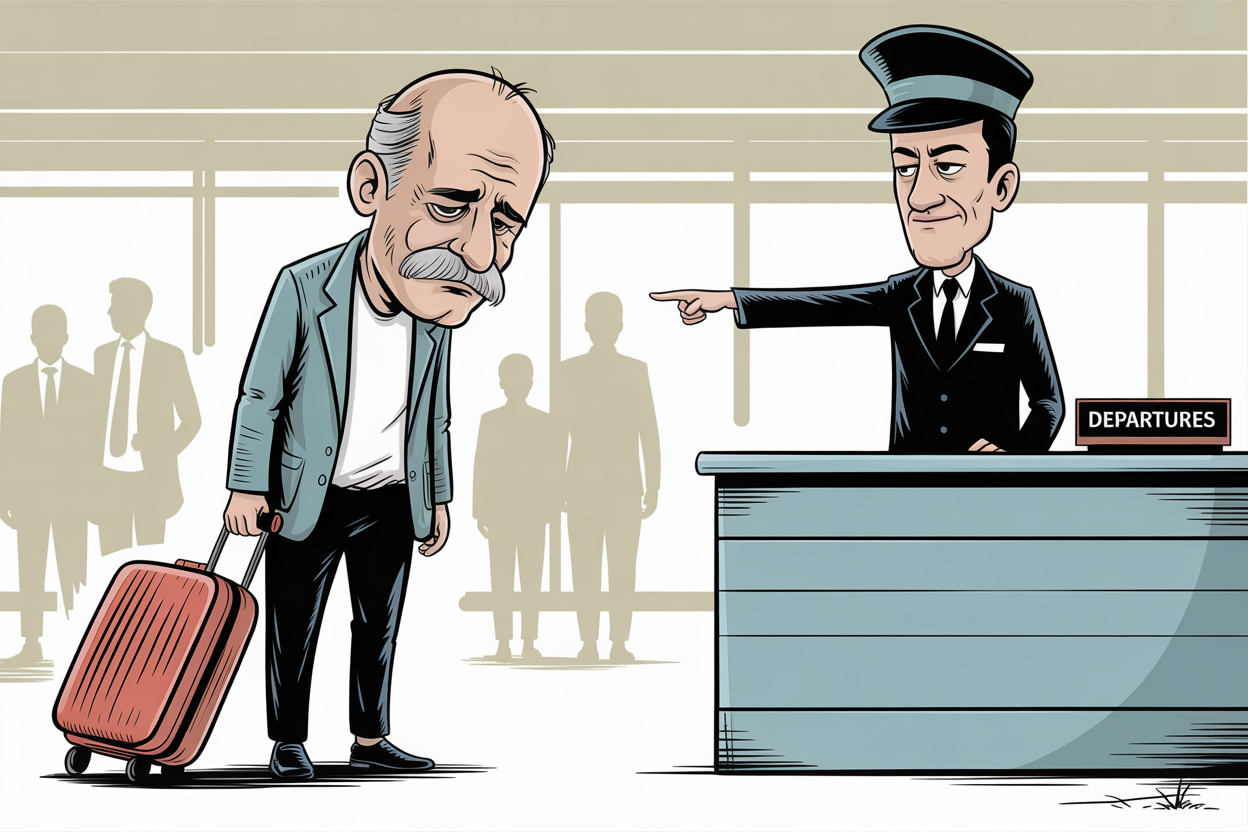
Black and white cartoon of a frazzled airline passenger facing a smiling gate agent at a counter, who holds up a document labeled "OUR RULES," illustrating the gap between what travelers want and what the DOT's disclosure rule actually delivers.

Congress asked for passenger rights. It got a PDF

Airline passengers are tired of standing at the gate while agents hand out excuses. The Department of Transportation has a fix. Soon, airlines will hand out a piece of paper instead. The DOT just finalized a rule requiring airlines to publish a one-page summary of passengers’ rights. Congress ordered it eight years ago. The rule does not set any compensation amounts. It does not require meals, hotels, or rebooking when there is a delay. Each airline only has to briefly summarize its own existing policies, in whatever format it likes. The rule also skipped the public comment period, and in a detail that is hard to make up, the summaries are not even due yet, because carriers cannot submit anything until a separate government approval process is complete. When the regulated industry shrugs at a new regulation, that means something, and this rule drew no objection at all.

An angry airline passenger stands with a suitcase while holding a $10 voucher after a flight delay.

The delay tax: Why your airline voucher barely covers your expenses anymore 

When a flight is delayed or canceled, airlines cover only what they call duty of care: a meal voucher, sometimes a hotel, or a refund if the flight is canceled. Angela Justice received a $10 voucher after her Boston to Chicago flight was canceled. The real cost, the delay tax, is far larger. It includes nonrefundable hotels travelers cannot reach, lost wages, child care that keeps ticking, and the replacement flights passengers must book themselves when the airline’s rescheduling timeline proves useless. Airlines calculate compensation based on what it costs them to reschedule a flight, not what it costs the traveler to miss the reason they flew in the first place. The official story is that duty of care solves the problem and the Department of Transportation signs off. But the law was written in a different era, when travel was simpler and airlines were more generous, and regulators have not caught up now that delays are chronic and carriers watch every penny.

Editorial illustration showing a thin man with brown hair and round glasses standing with arms crossed next to two orange roller suitcases on an airport tarmac with palm trees and a small white airplane visible in the background, illustrating a passenger left stranded after an airline schedule change forced him to buy replacement flights at his own expense

Aeromexico offered him a “free” flight change. Then it refused to give him one.

Jorrit Muller booked Aeromexico flight 335 from Puerto Vallarta to Orlando for a wedding. Three months before departure, Aeromexico shifted his flight one hour earlier, into the reception time. The airline notified him that if the new flight did not work, he could move to another at no additional cost. When he tried to use that offer through Aeromexico’s WhatsApp support, the available flights were operated by Delta as code-share. An agent told him to request a refund instead, then Aeromexico denied the refund. Under DOT rules, a significant change for international travel requires a schedule shift of six hours or more.