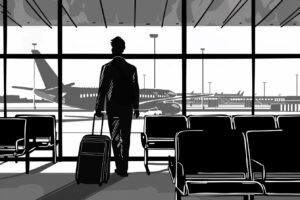





Too sick to travel? When to put yourself on the no-fly list

March 14, 2010

For Carol Margolis, it was an almost-ruptured eardrum.

She’d flown with a bad cold and sinus congestion, which made it difficult to equalize the pressure in her ears. After her doctor told her she’d nearly torn the lining between the inner and outer ear, and suggested she stay away from planes for a few weeks, she grounded herself.

“My hearing is too precious to risk,” says Margolis, who runs a travel Web site in Lake Mary, Fla. “I paid the change fees and stayed put.”

Not everyone makes the same choice. A recent poll by TripAdvisor suggests 51 percent of air travelers say they’d rather fly while infected with the flu than pay a $150 airline change fee. A similar survey by msnbc.com found nearly 60 percent of travelers would fly infected instead of taking the hit to their pocketbook.

That’s something worth considering as we approach the peak of the flu season. For every one Margolis, there’s at least one other passenger who refuses to cancel. Like Amanda, who asked me not to reveal her last name. She flew with the flu, even though she didn’t want to.

“I called Southwest to bump my flight by a day, and while the rep was kind, she couldn’t do anything but offer me the opportunity to pay the $300 change in fare,” she says. “Since this was not a possibility for me, I reluctantly dosed myself with cold medicine and endured the unending stares of everyone on the shuttle, in the security line and boarding around me on my flight and endured the most miserable six hours of my life flying.”

In case you’re wondering why Amanda wouldn’t let me publish her last name, have a look at the comments other travelers left for her when she confessed to being an infected passenger.

When should you add yourself to the “no-fly” list?

When your doctor tells you to stay home
“Some symptoms are just too high-risk to consider flying at all,” says Steven Schueler, an emergency room physician and chief executive of DSHI Systems, a health information systems company. If you suspect you may be too sick to fly, he recommends a medical risk assessment that considers both the seriousness of the symptoms as well the potential diagnosis. And if your doctor says don’t fly — don’t fly.

If the Centers for Disease Control says so
The CDC won’t necessarily come out and say, “Don’t fly if you have such-and-such,” but it does publish a helpful page on infectious diseases it’s trying to shield travelers from. Certainly, it’s safe to assume that if you have something like Tuberculosis, you might want to check yourself into a hospital instead of board a plane. The CDC site has suggestions to help avoid the spread of Swine Flu that should also be heeded.

If you’re on the sick list
The list comes to us courtesy of Michael Zimring, the director of the Center For Wilderness & Travel Medicine in Baltimore: Don’t fly if you’ve had a significant sinus congestion, surgery on a lower extremity, a recent heart attack or cardiac surgery, uncontrollable heart failure, or recent abdominal or neurosurgery. “A patient of mine just had an emergency appendectomy and he wants to leave for Vegas in a few days,” he says. “That is a no-no.” Why? The patient will have residual air in his abdomen from the surgery and when he gets to altitude, the air will expand within the closed confines of his abdomen and cause major problems. Ouch!

If you can’t get around much anymore
“Generally speaking, someone should not fly if they are unable to walk about 150 feet or climb one flight of stairs without becoming short of breath,” says Mark Gendreau, an assistant professor of emergency medicine at Tufts University School of Medicine. “Keep in mind that commercial flight subjects us to both physiologic and environmental challenges.” Such as? Cabin pressure is set to 5,000 to 8,000 feet above sea level, he notes, which results in a lower oxygen saturation in your bloodstream, in addition to the expansion of gases in body cavities.

If you’re really nervous
The worsening of an underlying anxiety condition can be a cause for cancellation, too, according to Margaret Lewin, the medical director of Cinergy Health, a Miami health insurance company. Fear of flying is no laughing matter to the estimated 1 in 5 people who suffer from it, and should be taken into account when you plan a flight. Aerophobia can be treated, and you should always have a Plan B. “You’re best protected if you consider possible problems ahead of time,” she says, adding that flight or trip cancellation insurance should be considered. Note that many policies have exceptions for pre-existing conditions, so only a “cancel for any reason” policy is likely to cover an anxiety disorder.

Another thing to consider is the return trip. If you’re feeling unwell now, and decide to fly anyway, could your condition worsen by the time you’re ready to return? Myles Druckman, the vice president of medical services for International SOS, a medical healthcare company, says it happens more than you’d think.

“It is good practice to only travel when you are well,” he says. “If you have a symptoms of illness, you should address these concerns prior to travel, particularly if you plan to travel internationally. It is important to consider that your symptoms may worsen while on a trip, and this may require you to seek medical attention locally.”

That’s all well and good, but it would help if the travel industry — particularly airlines — loosened their onerous change rules when a customer fell ill. On legacy carriers, change fees and fare differentials often exceed the value of the original ticket, forcing passengers to choose between flying sick or throwing a ticket away.

No one should have to make that choice.

(Photo: zpeckler/Flickr Creative Commons)

✓ Get the latest travel news, tips and commentary from Elliott’s E-Mail, the subversive newsletter from consumer advocate Christopher Elliott. You’ll travel like a pro. Sign up here. It’s free.

Similar Posts:

Related Posts with Thumbnails

10 comments

{ 10 comments… read them below or add one }

Crissy March 14, 2010 at 9:04 am

A couple years ago I was going away on a month long trip. Based on when my flight was and when I started getting cold symptoms, it’s quite likely that I caught something on the flight over. I ended up sick for almost the whole month and a cough lingered past my trip. Having said that, I can still understand flying with a cold, but the flu? I wouldn’t want to fly with the flu myself and if I couldn’t afford the change fee then maybe I shouldn’t be traveling. And then to get the flu once I’m on my trip, that would be horrible.

sweepergrl March 14, 2010 at 10:16 am

I agree that, in theory, no one should fly when they’re sick. Until the airlines waive some of their stupid rules and fees, though, people will fly sick. Unless, of course, they can afford to eat the $150 per ticket and any money lost on hotel and car reservations.
A week before my sister’s wedding in Florida, I came down with what the doctor diagnosed as shingles. He said no flying so I immediately contacted the airline. I offered a doctor’s note, begged and pleaded, but the airline wouldn’t budge and said I would have to pay the $150 fee for myself and my child. This left a $54 credit for each of us to use against a new ticket. What a joke. I do not have the money to buy walk-up fares for two, which is what I would have had to do and I bet a lot of people don’t, either.
The worst part was when I flat out asked the customer service rep how she could defy doctor’s orders and push me to fly with an infectious disease. She replied, “We aren’t telling you to fly sick. We’re assessing our fees because you insist on changing your ticket.” What kind of logic is that?
The nightmare had a happy ending, though. It wasn’t shingles after all, which saved me the guilt that would have come from flying sick.

Sean March 14, 2010 at 10:16 am

Great, another bout of, “If you can’t afford it . . . ” posts. I’m sorry, but paying $300 for a change fee is obscene, and no one should have to pay it. People don’t plan on getting sick and I respect anyone that takes themselves off a flight while they are sick, but I also understand when those that need to be somewhere or don’t want to pay the change fee take a flight while sick. I travel for business and I won’t fly out if I’m sick, but I sure will fly home if I’m sick as I’d much rather be at home then stuck in a hotel.

I’m going to change it around, If you don’t want to fly with sick people, may you shouldn’t be flying and should find another means of travel. Flying with healthy people is a privilege, not a right.

Susan March 14, 2010 at 10:17 am

I can definitely understand flying when sick. I have in the past because I needed to get home and return to work..Maybe if the airlines wouldn’t charge $150.00 to change a ticket ( a piece of paper) more people would stay off planes when sick. Most airline tickets are bought in advance and vacation time is put in at work so changing your schedule is not as easy as written. The airlines are so overbooked now with less flights if you try to change a ticket it could take 2-3 days off your vacation as the next flight is booked already. Unless something is done on the airlines end I don’t see many people changing reservations because they are sick.. Just do what I do when I hear coughing around me on a plane, don’t turn on the air above your seat, so far it has worked well..

Alan Gore March 14, 2010 at 6:12 pm

I wish I didn’t have to fly with the flu, but being retired I can’t afford to eat the cost of my ticket. So long as I still stagger onto the plane, I’m going.

Allison March 15, 2010 at 12:58 am

I recently flew back from Europe with a horrible sinus infection. I would have loved to have spent a few days more in Vienna to have my condition improve but two things prevented me: 1. I also had injured my knee and had no reasonable medical assistance option, and 2. My airline (Iberia) told me I would have to wait two weeks to fly my itinerary due to “capacity controls.” In February? It’s one thing to not start travel due to a medical condition; it is something entirely different when one is trying to get home.

abigail@ west bengal travel March 15, 2010 at 2:36 pm

Very intelligent way of representation. I like your writing style. i think people should not fly when they suffering form flue or something else . A good descriptive article.Thanks for the detail informative post.

Sarah Di March 15, 2010 at 3:57 pm

I think a major problem comes in when other passengers or staff try to make a determination about whether you should have flown or not. Just because someone is coughing doesn’t mean they’re contagious. Maybe it’s dry air or they ate something that went down the wrong way. Maybe they’ve had a cold but they are on the tail end of it and they are fine to fly. Typical symptoms of a cold or the flu can also be symptoms of other problems that are not contagious or dangerous to others in any way. I can have sinus problems and sound completely horrible but not be contagious.

Also, most people who are flying probably could afford the change fees, if it were budgeted. But since a bad illness tends to come up right before a trip, 100 – 150 dollars per person might not be in the budget.

Elisa March 15, 2010 at 5:37 pm

Sorry but where is the travel insurance in this discussion? If you contract the flu, a good policy would cover that and mean that you were less out of pocket than the change fee. Perhaps we should be choosing the credit card with the built in insurance?

I agree the change fees are obscene. I can understand them if it’s within 48 hours of the flight though – airlines know that seat will be hard to sell again, so they would be losing out on the $ if you change your flight.

Carver March 16, 2010 at 12:50 am

Does Travel insurance cover your hotel if you get sick whle traveling?

Leave a Comment

Previous post:

Next post: