




More fallout from ExpressJet Airlines 2816 fiasco: The National Business Travel Association has thrown its weight behind a “turn back” rule for airlines, a remarkable reversal for an organization with a consistent pro-business and often pro-airline record.
The move leaves the US airline industry almost entirely friendless in Washington, at least when it comes to passenger rights legislation being considered by Congress, and it may be one of the final nails in the coffin of efforts to keep the government from regulating the controversial tarmac delays that have attracted so much public attention recently.
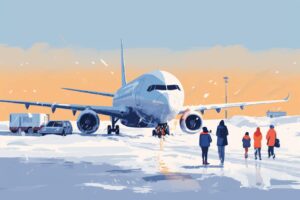
NBTA’s move is significant, because its members apparently demanded that the organization change its position after the Continental/ExpressJet tarmac delay, in which passengers were forced to spend the night on a tiny regional jet parked near a gate in Rochester, Minn.
Kevin Maguire, NBTA’s president, expains:
For years, the business travel industry believed the airlines and the federal government would work together to fix the problems that led to excessive tarmac delays, but enough is enough.
When we’ve got travelers stuck on planes sitting on the tarmac overnight, it’s clear the problem has spun out of control, and legislation is the best solution. We need to hold the airlines to a ‘bright-line’ rule that respects the basic humanity of passengers by preventing airlines from keeping them captive, which is exactly what the Snowe-Boxer language will do.
Maguire’s language reflects the sentiments of my colleague, Consumer Travel Alliance president Charlie Leocha, who went a step further today, calling on the government to punish the airline CEOs for tarmac delays.
The only question now is: Who’s next?
NBTA is the largest business travel organization. It’s unclear if the second-largest business travel group, the Association of Corporate Travel Executives, has taken a position on this issue.
Now would be the time, of course, for the membership organizations in Washington — those representing the interests of everyone from travel agents to destinations — to take a stand for their customers.
NBTA is showing some leadership on this important issue. Who will join it?
(Photo: caribb/Flickr Creative Commons)
✓ Get the latest travel news, tips and commentary from Elliott’s E-Mail, the subversive newsletter from industry gadfly Christopher Elliott. You’ll travel like a pro. Sign up here. It’s free.

Sign up for my 


{ 1 trackback }
{ 8 comments… read them below or add one }
Speaking from a purely personal perspective (I can’t speak for ATME on this matter), I think the airlines have had plenty of wakeup calls re this issue. I don’t think we would even be considering a law in Congress if the airlines would just use some old- fashioned common sense. The Rochester situation was just plain dumb and a PR disaster for Continental, ironically an airline that actually had a policy in place. But this was a commuter affiliate that wasn’t as savvy. OK, but back to the common sense thing; shouldn’t Continental have thought to mention their policy to their affiliates. Now, after the fact they have. And this particular problem won’t happen again.
Can’t these airlines think ahead re worse case scenarios and find solutions that get implemented. I understand that Northwest after their tarmac fiasco years ago, now stores water and snacks on all their planes.
This isn’t rocket science. People, the elderly, people with babies shouldn’t have to sit in a plane with no toilet, no water and no food overnight. At the very least someone at the airport should have thought to go to a 7-11 and buy water and snacks if they truly couldn’t get off the plane (which apparently was never true).
It’s down to this, if the airlines had really addressed this issue, found real solutions to this ongoing problem, organizations like NBTA wouldn’t be backing this Passenger Bill of Rights. Put this issue in the hands of airline marketers instead of operations and I’ll bet solutions would have been found. Marketers recognize how a brand can be badly tarnished with just one incident. I just see millions of marketing dollars going down the drain.
Why is the refusal of the Continental Express crew to allow passengers to leave the plane not a criminal matter?
If I invited 47 people to my house for a 3 hour dinner party, and then locked the door and refused to allow them to leave for an additional 9 hours, I would surely be arrested and charged with kidnapping and/or false imprisonment.
Why is this not the appropriate response to this matter, and also the most just, in terms of respecting the rights of the victims?
This will only be fair if, in the event of another such delay, any passengers who decide it is time to leave the plane pop out an emergency window and make a break for it, are not subject to prosecution, except the costs of replacing the window.
What if someone had needed emergency medical care? Would the crew have called an ambulance and had the EMTs meet the plane on the tarmac? If an elderly person had suffered from dehydration (as the elderly are most susceptible to), would the crew have made some sort of provision for water?
I agree with Dan. This action should be criminalized.
If there is going to be a turn-back policy, I think the airlines would prefer that it be done by gov’t regulation. If they “turn back” on their own, and the plane misses a take-off window, the passengers will be mad at the airline for further delaying their flight. If they are required to turn back, then they can blame the law.
I am currently an airline disparcher for one of the highest rated regional carriers and have been in the industry for over 30 years. Why these situations happen once is a mystery to me, how they can happen over and over again really make me mad. With the draconian cutbacks and termination of seasoned employees I can somewhat understand how a meltdown like NW can happen but Expressjet is a small player, and RST is a tiny airport. NOBODY at any point in this mess took responsibility for the situation, from the dispatcher to the pilot in command to the CEO. Nobody took responsibility and nobody will be held accountable at Expressjet. Expressjet enjoys the fruits of very cheap and pliable labor and isn’t about to change their standards based on some little thing like holding 47 customers hostage overnight. If CO had any desire to protect their brand, they would do something. They won’t because Expressjet gives them cheap seats to sell. And so it goes, until the next fiasco.
I think that the US Government needs to step in and adopt a regulation saying that any passenger held “hostage” for three or more hours shall receive payment from the airline of ten times the amount paid for the ticket with a per-passenger minimum of $1,000. Passengers held more than 6 hours get 20 times ticket cost / minimum of $2,000. Nine hours would be 30 times ticket cost / minimum of $3,000. The compensation would have to be in US dollars, not travel vouchers or mileage points. The only way that the airlines are going to learn that they can’t lock people in a plane for unreasonable periods of time is to make them pay dearly for doing so.
Jail time work work, too:
http://www.airliner.net/blog/continental-express-tarmac-delay
It looks like Dan and jj are reading from the same blog. Look, I find it equally improper for the crew to confine people for this unreasonable amounts of time. But as an attorney, any analysis of false imprisonment is just off the mark. The reason is that the airline crews are empowered by federal law to prohibit passengers from disembarking from the plane. As long as the crew is acting in good faith, then there is no crime committed here. Its the same as when law enforcement order you to do or not to do something to protect the safety of the public.
If we want any relief from this sort of thing repeating itself it must come from the federal government. By the way, the State government has very little to say in the matter.